fortifications


The  palmetto tree (Arecaceae Sabal palmetto) is our state tree and a familiar emblem in South Carolina, adorning our majestic state flag as well as t-shirts, beer bottles, and a myriad of mundane objects. All good South Carolinians know, of course, that the “Palmetto State” honors the palmetto in memory of the events of 28 June 1776, on which date a small number of brave soldiers lodged in an unfinished palmetto-log fort on Sullivan’s Island successfully repulsed a large invasion force of the British Navy. It was the first significant victory for the American “rebels,” a week before the Continental Congress ratified the Declaration of Independence in Philadelphia.

Beginning in 1777, the 28th of June has been regularly celebrated in South Carolina (well, mostly in the lowcountry), as “Palmetto Day” or “Carolina Day,” and these commemorations represent a treasured heritage for many in our state. The Palmetto Society (formed in 1777) in conjunction with the South Carolina Historical Society, for example, lead an annual parade down Meeting Street to White Point Garden. The National Park Service staff at Fort Moultrie on Sullivan’s Island annually hosts a fun day of educational events at the site of the original battle. Many in our community are unfamiliar with this venerable tradition, however, and thus we feel compelled to help spread the word about this most deserving of anniversaries.

To commemorate the 236th anniversary of Carolina Day, Dr. Nic Butler, public historian at the Charleston County Public Library, will present an illustrated lecture examining the use of palmetto trees in the construction of fortifications on Sullivan’s Island, James Island, and even downtown Charleston, between 1775 and 1780. The public is invited to attend this free program on one (or all!) of the upcoming dates:

The Palmetto Tree:

Defender of South Carolina, 1775–1780.

Saturday, June 22nd 2013 at Noon: Edgar Allan Poe Library, 1921 I’On Avenue, Sullivan’s Island, SC 29482

Tuesday, June 25th 2013 at 6 p.m., James Island Library, 1248 Camp Road, Charleston, SC 29412

Wednesday, June 26th 2013 at 6 p.m., CCPL Auditorium, 68 Calhoun Street, Charleston, SC 29401
Don’t forget–Wednesday, May 22nd is the day for the illustrated lecture, “A Brief History of Broughton’s Battery, 1734–1784.”

The program starts at 6 p.m. in the 2nd Floor Classroom at the Charleston County Public Library, 68 Calhoun Street.

I hope to see a phalanx of Walled City fans there!


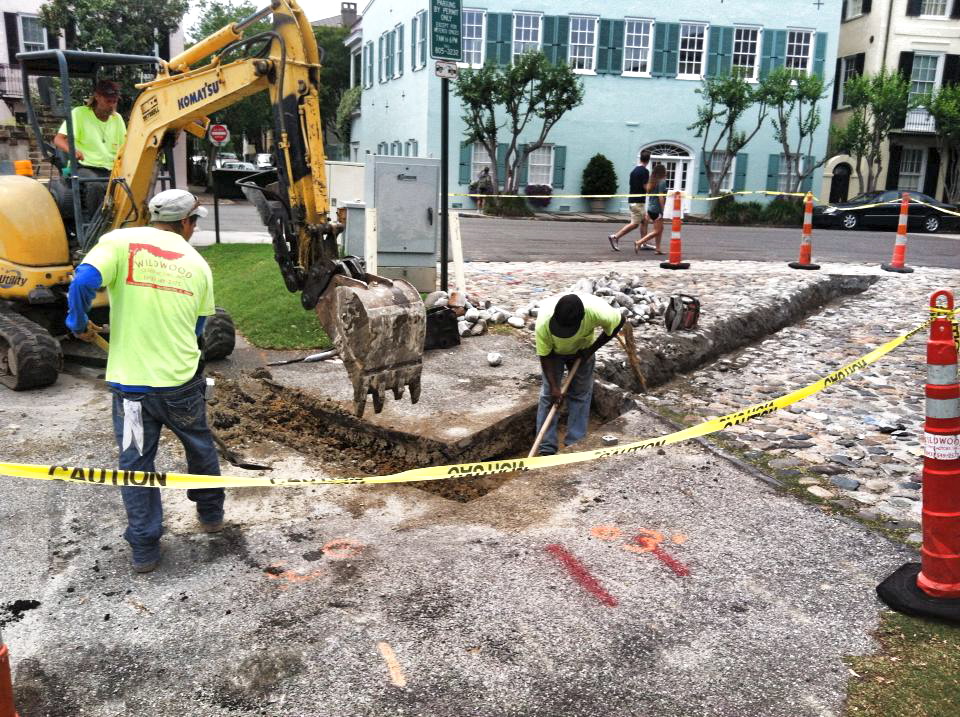
Following the 2008 and 2009 excavations of the colonial-era redan at the east end of Tradd Street (now South Adger’s Wharf), the Mayor’s Walled City Task Force began planning with the City of Charleston to depict the outline of the redan’s foundation on the present landscape. After considering and dismissing several methods and materials for accomplishing this goal, Mayor Joseph P. Riley insisted that brick should be used in order to render the outline as visible and as durable as possible. Some months ago Charleston Museum’s archaeologist Martha Zierden used spray-paint to touch up the series of pink dots on the road surface that indicate the outline of the redan’s inner and outer faces. This morning workers used masonry saws to connect those dots, and removed the asphalt and cobblestones between the inscribed lines. In the coming days, we’ll see the finished effect–a handsome brick pathway that follows the precise outline of the redan’s walls, which remain standing just two feet below the modern surface. The public is invited to visit South Adger’s Wharf and view the new work. If you can’t make it down to the site, enjoy these photos taken by task force co-chair, Katherine Saunders Pemberton, earlier today.  480822_10151683727331264_1591341619_n943555_10151683729741264_2075123487_n

Over the past several months I’ve presented lectures surveying the history of the brick fortifications built along Charleston’s eastern waterfront. From Granville’s Bastion at the south end to Craven’s Bastion at north end, approximately seven million bricks were laid between 1696 and 1713. These defensive works stood until the 1780s, and their foundations remain under our streets at sidewalks today.

Profile of an earthen entrenchment by John Muller

Profile of an earthen entrenchment by John Muller

But what about the early walls that surrounded the north, west, and south sides of the town? What about Colleton’s Bastion, Ashley’s Bastion, Carteret’s Bastion, and Johnson’s Ravelin? The surviving documentary evidence suggests that these fortifications were made of earth and wood rather than brick, and conceived from their inception to serve as temporary works. Details of their construction are sparse, but they are certainly interesting. When and where were these earthen structures built, and what did they look like? Please join me for an illustrated survey of this fascinating part of our city’s military history.

“Earthen Entrenchments and Bastions in Charleston, 1703–1734

Wednesday, March 27, 2013 at 6:30 p.m.

2nd Floor Classroom,

Charleston County Public Library

68 Calhoun Street

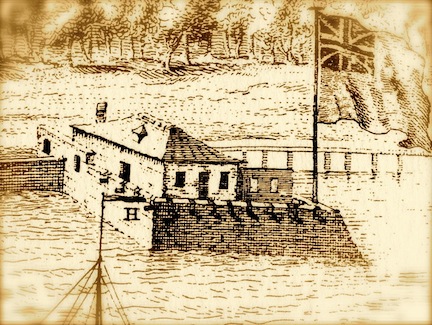
1739 View of Craven's Bastion

1739 View of Craven’s Bastion

Craven’s Bastion was built in the early 1700s and formed the northeast corner of the colonial “walled city” of Charleston. During the war with Spain in the 174os, scores of Spanish prisoners were housed here in miserable conditions. During the British occupation of the city in 1780–82, Craven’s Bastion was used as a civilian jail and headquarters of the “town police.” Like the rest of Charleston’s colonial fortifications, the bastion was demolished after the American Revolution, however, and the remnants of its brick walls are now hidden under East Bay Street and the steps of the U.S. Custom House (built 1853–79). Using clues from colonial-era documents and new archaeological technology, it might it be possible to pinpoint its precise location and dimensions. Please join Dr. Nic Butler for an illustrated overview of this important Charleston landmark.

“A Brief History of Craven’s Bastion, 1703–1789”

Wednesday, February 27, 2013 at 6:30 p.m.

2nd Floor Classroom,

Charleston County Public Library

68 Calhoun Street

« Previous PageNext Page »