Charleston


This week, while re-reading the 1706 journal of the South Carolina Commons House of Assembly, I came across a bit of colorful text that had previously escaped my attention, and I thought others interested in Charleston’s early fortifications might find it interesting.On 7 March 1705/6, at the opening of a new legislative session, Governor Nathaniel Johnson delivered a speech in which he reminded the House of its duty to provide for the proper defense of the young colony. As was customary, the House then appointed a committee to draft a formal reply to the governor’s speech, and on 12 March they presented their draft before the full House. After it was read and approved, the Speaker of the House, Lt. Col. William Rhett, affixed his signature to the message and then ordered it to be sent to the governor. Among the obligatory formal language contained in the reply, the House expressed its concurrence with the governor’s concerns about the state of the fortifications, and included this metaphorical phrase:

It is no Doubt a Duty which we owe to God and ourselves[,] to the present Age and to Posterity[,] to Improve the Opportunity God gives us of ffenceing [sic] our Vineyard; and makeing [sic] the Hedge about it as Strong as we can.

At this time, Charleston (then called Charles Town) was a heavily fortified, walled settlement. It was the political capital of the infant colony, the sole port and market, and the store of nearly all the provincial armaments. In comparing the town (and, by extension, the colony) to a vineyard surrounded by a hedge, the members of the Commons House used their linguistic skills to help us, more than 300 years later, to understand the importance and value of their efforts to defend the once struggling colony that we now take for granted.

This Thursday, October 18th, you’re invited to join members of the Walled City Task Force and the Young Advocates of the Historic Charleston Foundation for a fun and educational evening. It’s time for the autumn “Walk the Walls” event, and the weather should be just right for a bit of history, food, drink, music, and conversation under the stars in Charleston. Come join us at 40 East Bay Street at 6:00 p.m. for a self-paced stroll along the path of Charleston’s early defensive walls. At significant points along the way, you’ll meet interpreters who’ll help breath life into the history of that site. We’ll finish the evening off with dinner and music harbor-side at the Missroon House, where you’ll have a chance to chat with other “walled city” enthusiasts. Besides having a great time, you’ll be contributing to the Task Force’s preservation efforts.

I hope to see you there!

Whenever I give a presentation on the history of Charleston’s colonial fortifications, I always start with the wall that once stood on the east side of East Bay Street. This wall, identified in the colonial records as the “wharf wall,” “curtain wall,” or “front wall,” was the starting point for the effort to fortify Charleston more than three hundred years ago, and it was among the last parts to be dismantled after the American Revolution. Here’s a very brief overview of what I know about it so far.

In 1680, when “New Charles Town” was established on the present peninsula, a “wharf” sixty feet wide was laid out on the east side of East Bay Street, stretching from the site of the present Missroon House to the Exchange Building at the foot of Broad Street. Since there are no extant legislative records from the 1680s, we don’t know what this “wharf” was made of, or what it looked like. Similarly, we don’t know anything about the construction of the “tranchée” or entrenchment (probably an earthwork wall) that is depicted along the east side of East Bay Street in the Jean Boyd map of 1686 (published in the 2006 Transactions of the Huguenot Society of South Carolina). In 1694, the S.C. legislature passed the first law authorizing the construction of a brick “wharf wall” or “curtain wall” along the east side of the street, but due to a shortage of bricks and bricklayers construction apparently didn’t start until 1696. Governor Nathaniel Johnson reported in late 1704 that this project was still not finished, but the curtain wall was apparently completed by August 1706 when a French and Spanish fleet made an unsuccessful attempt to invade Charleston. Based on account statements from 1704, I estimate that approximately four million bricks were used to build the curtain wall (excluding the bastions) between 1696 and 1705.

Between 1711 and 1728 the brick curtain wall sustained extensive damage from several severe hurricanes, and thus it was substantially rebuilt and apparently enlarged between 1725 and 1739. Near the end of that era the South Carolina legislature and Charleston merchants negotiated over the size of openings to be left in the wall to allow carts to move between the wharves to East Bay Street. The legislature wanted ten-foot openings; the merchants wanted thirty-foot openings. They settled on openings fifteen feet wide. The legislature also passed restrictive measures to prevent the building of residences or any tall structures to the east of the curtain wall. Any structures built in that area, the legislature decreed, would have to be razed in a moments notice in the event of an invasion. In 1745 the curtain wall was described in a London magazine as being “six feet over.” This statement may have meant that the wall was six feet tall, or it may indicate that it was six feet wide at the top. I suspect this number refers to the height of the wall, but we hope to find out in the upcoming archaeology at South Adger’s Wharf.

The wharves projecting out from the on the east side of East Bay Street in to the Cooper River grew substantially between the 1720s and the American Revolution, but the brick curtain wall remained standing throughout these years. After the conclusion of the war with Britain in the spring of 1783, the S.C. legislature waited a full year before authorizing the demolition of the fortifications in Charleston. The work of dismantling the brick wharf wall on the east side of East Bay Street began in late 1784 or early 1785. In the spring of 1787, the legislature finally repealed the old law restricting the size and nature of buildings on the east side of East Bay Street. From that time forward, the wharves of Charleston began to be filled in and built up, leading to the streetscapes that we now see.

Over the past year I have presented a chronological overview of the rise and fall of Charleston’s colonial fortifications for a number of different audiences in the Charleston area. On nearly every one of these occasions, someone has asked if I can give them a summary or outline of this material, which is taken largely from unpublished archival sources. Eventually I do plan to publish the full scope of my research in an illustrated monograph, but in the interim I am happy to oblige with a basic outline of the story.

Under the Educational Resources page of the Mayor’s Walled City Task Force website, I have inaugurated a “Time Line” that will eventually contain four sections covering the Proprietary, Royal, Revolutionary, and Post-Revolutionary eras of Charleston’s early fortifications. The first part, covering the Proprietary Era of 1663-1719, is now online. The remaining parts will be posted in future weeks.

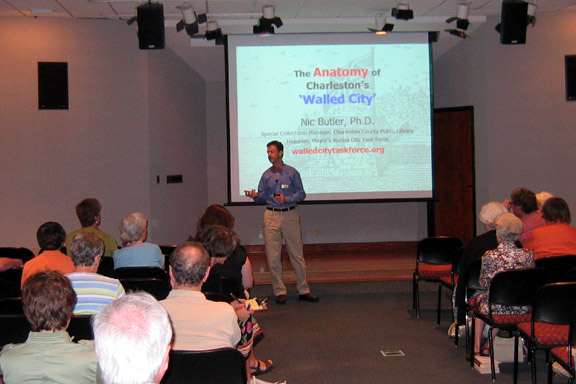
butler_15_sept_2007.jpg butler_15_sept_2007_2.jpgThank you to everyone who attended Saturday’s program, “The Anatomy of Charleston’s Walled City.” Based on the numerous questions and positive comments received afterwards, I feel confident that the audience left with a better understanding of the materials and design principles used to build the defensive walls that surrounded colonial Charleston. I hope all 72 of you in attendance found it an educational and entertaining way to spent the afternoon.On Saturday, I was also pleased to make two new public announcements on behalf of the Task Force: first, the availability of this new website, and second, the upcoming archaeology to be done at South Adger’s Wharf (see the 14 September posting by Katherine Saunders). We sincerely hope that this electronic forum will help us raise awareness of Charleston’s colonial fortifications and encourge the public to learn more about this fascinating topic.For those of you who weren’t able to attend on Saturday, I’ll be repeating the program on Monday, 29 October 2007, at 7:00 p.m., in the Auditorium of the Charleston County Public Library.

« Previous PageNext Page »