archaeology


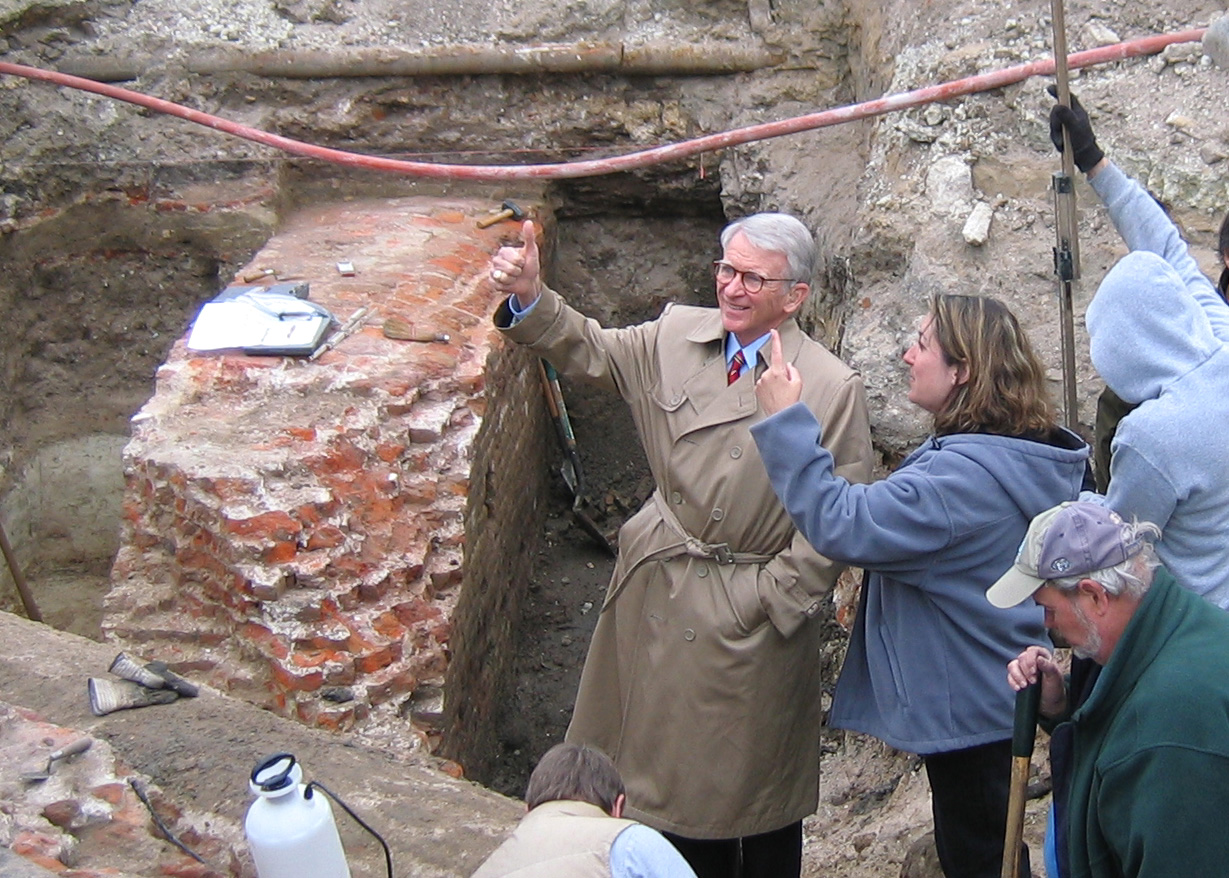
Last Friday, March 14th, a crew working for the City of Charleston’s Parks Department encountered some curious brickwork while digging a trench behind the Hazel Parker Playground on East Bay Street. Rather than shrugging their collective shoulders and continuing with their work, Project Manager Bill Turner picked up the telephone and called archaeologist Martha Zierden of the Charleston Museum to ask her opinion of the brickwork. Martha was working in the field beyond Charleston, however, as was archaeologist Eric Poplin of Brockington and Associates. Martha managed to contact me and Katherine Saunders, co-chair of the Walled City Task Force, and she and I met at the playground, just one block south of the recent archaeological dig at South Adger’s Wharf.

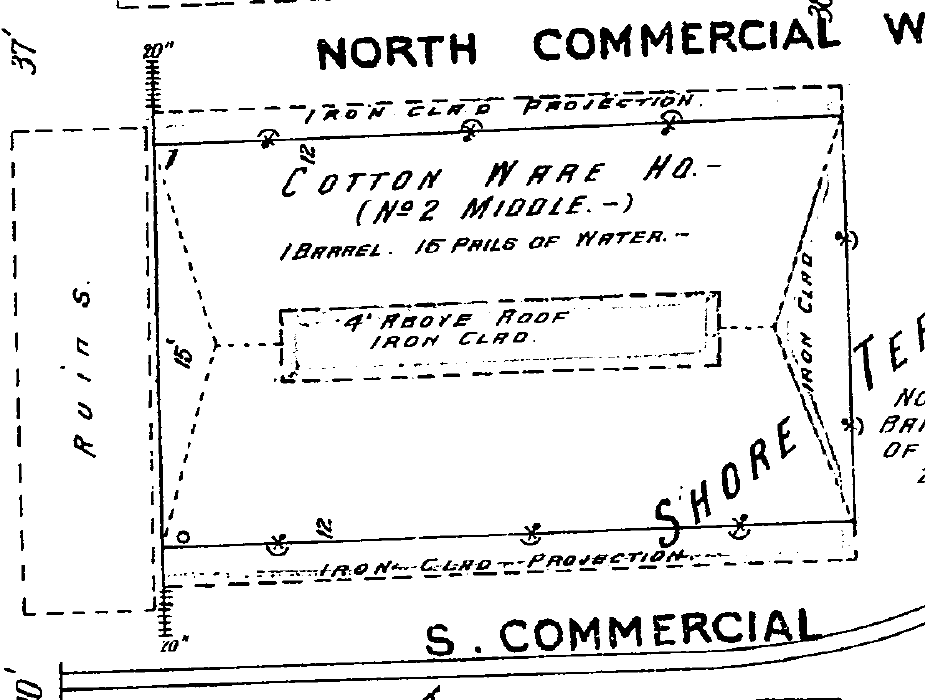
1884_sanborn.gifThe entrance to the Hazel Parker Playground is through a rectangular one-story brick building at 70 East Bay Street, behind which are outdoor facilities for tennis, basketball, and baseball. 1902_sanborn.gifThe brick building dates from the early years of the twentieth century, and is built on the site of a slightly larger three-story commercial structure that stood for most of the nineteenth century. An image of that building, from the 1884 Sanborn Insurance Map of Charleston, is seen above left. The 1902 edition of the Sanborn map of Charleston shows only “ruins” of this building, as seen here to the right.
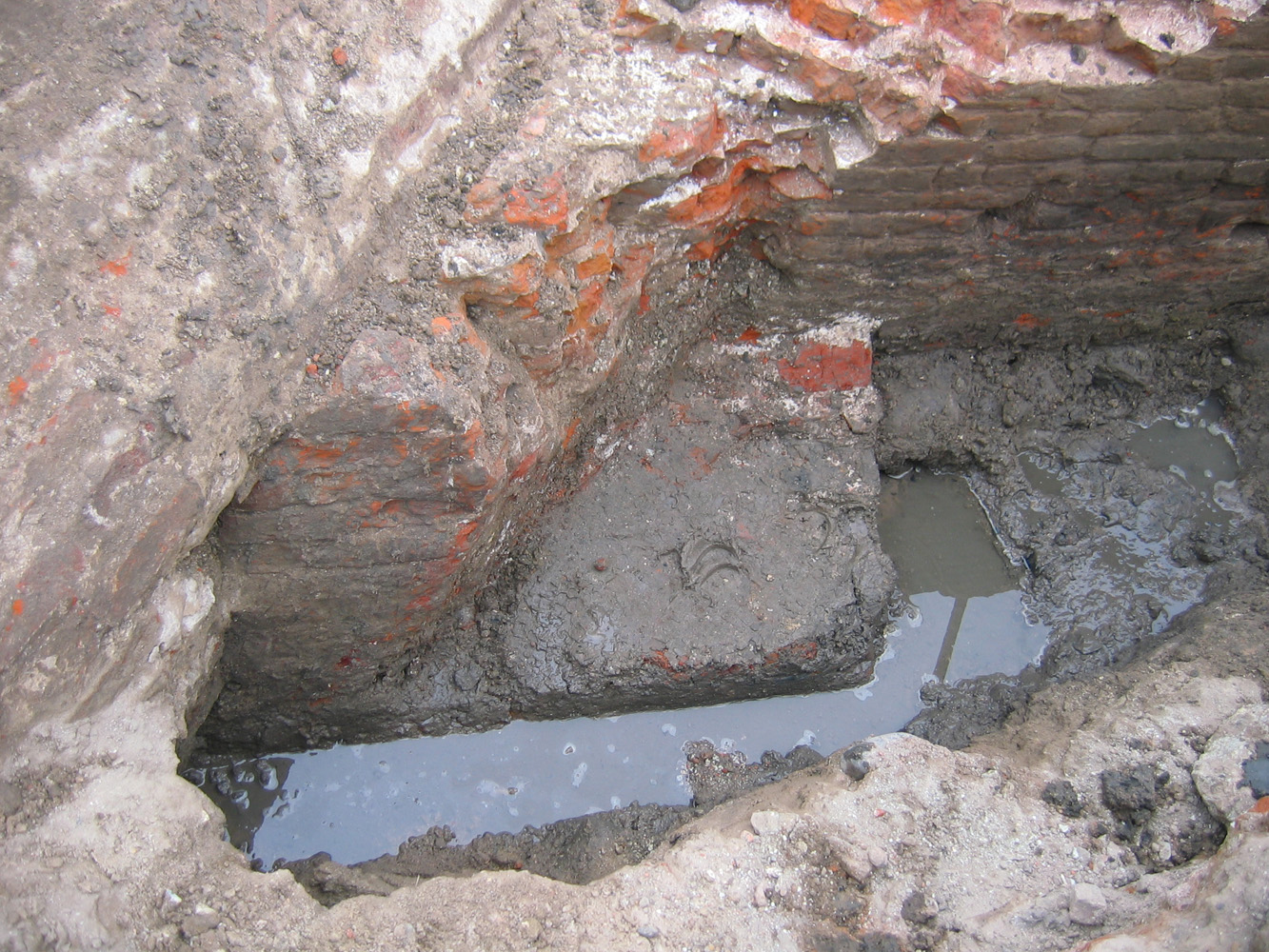
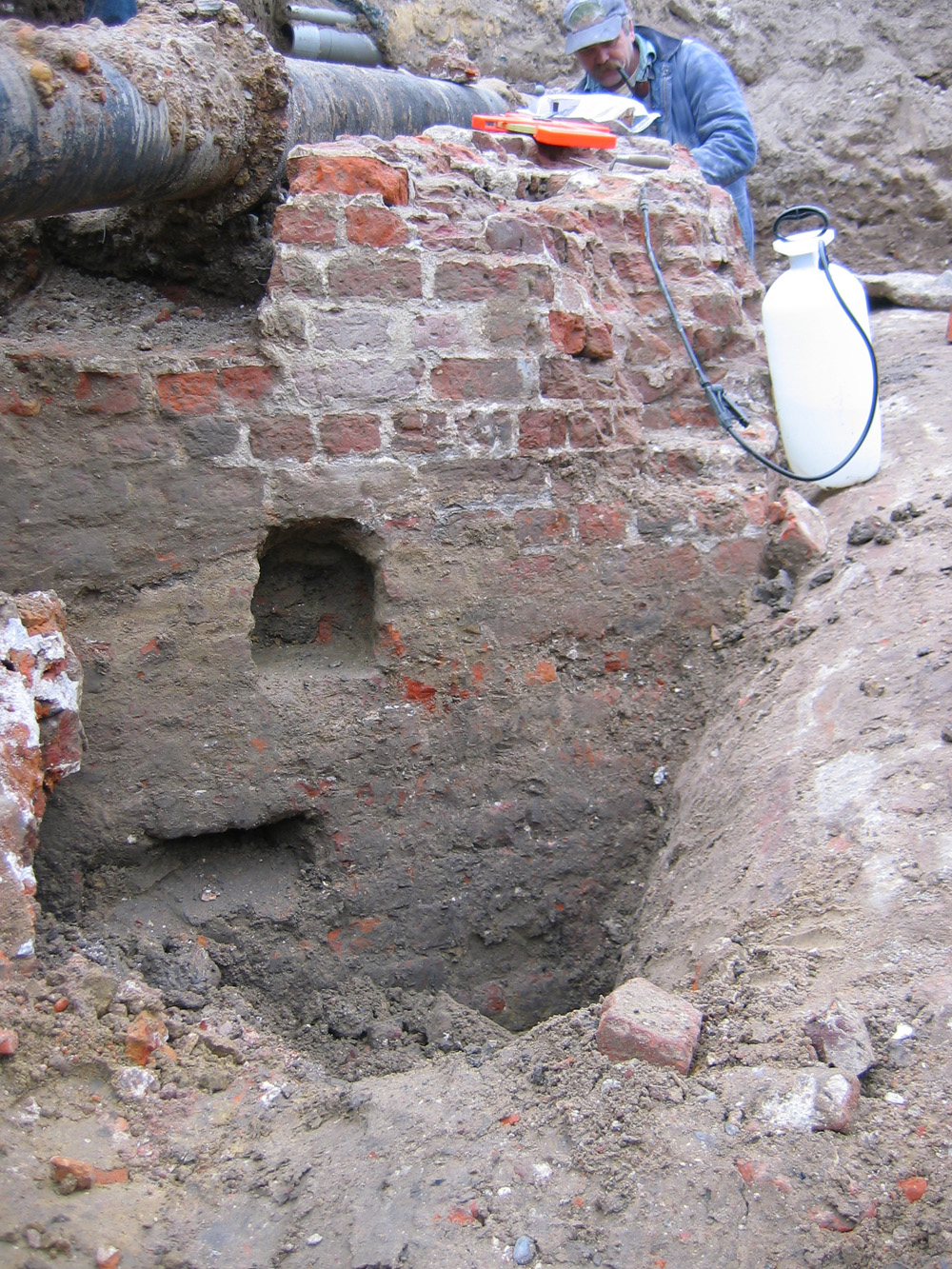
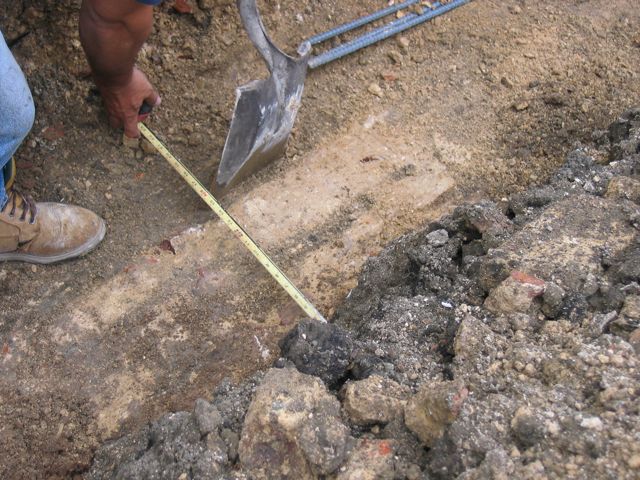
hazel_parker_playground_01.jpgA work crew had recently cut a trench along the back wall of 70 East Bay Street in order to build brick buttresses to strengthen the east side of the building. In the trench they discovered a continuous line of brickwork running parallel to and about three feet east of the existing building. The western edge of this brickwork was visible in the trench (see the photo to the right below), but the eastern edge was buried below the mound of earth removed from the trench. hazel_parker_playground_02.jpgThe exposed portion of brick was approximately two feet wide, but the full width of the wall could not be determined. At any rate, Katherine and I concluded that this brickwork most likely represents the foundation of the eastern wall of the nineteenth century commercial offices that once stood in front of the cotton warehouses and wharves of the Commercial Cotton Company.
While this brick foundation wall runs parallel to the old “curtain line” of the colonial fortifications along the east side of East Bay Street, it’s located more than thirty feet east of that historic wall. Our site visit last Friday didn’t turn out to be associated with the “walled city,” but we greatly appreciate the spirit of cooperation that inspired Mr. Turner to share this discovery with the Task Force. We look forward to many more such opportunities to share in the process of uncovering Charleston’s past.
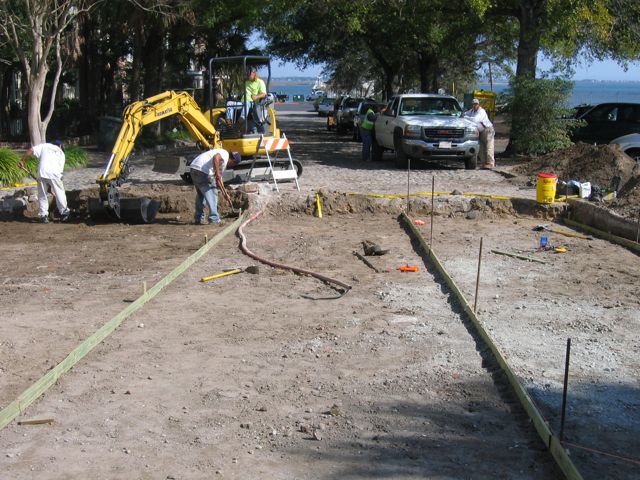
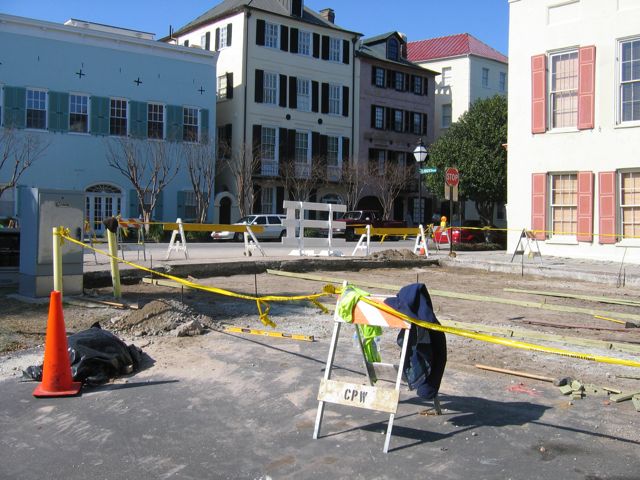
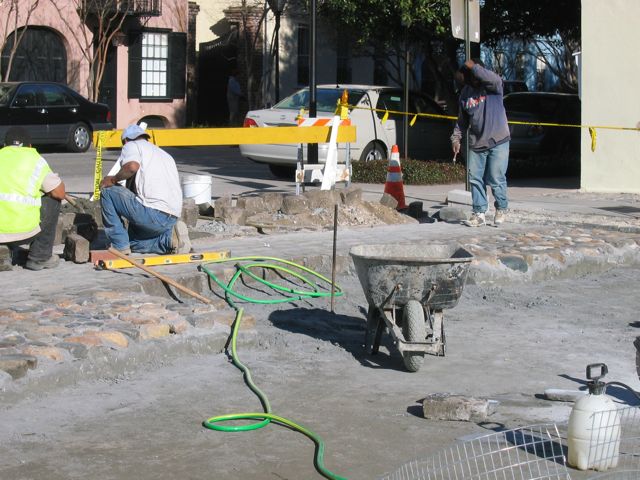
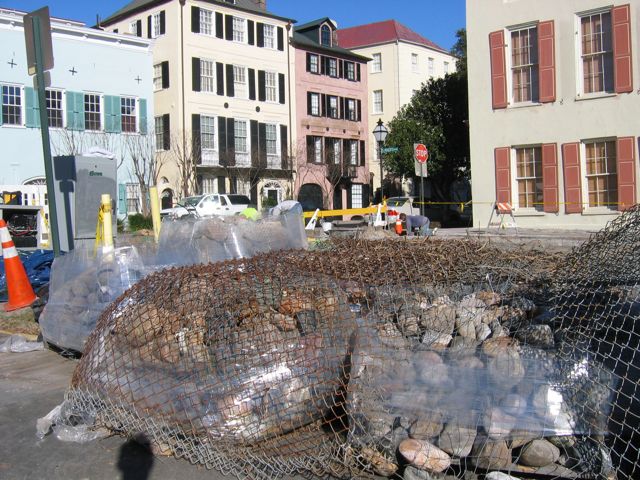
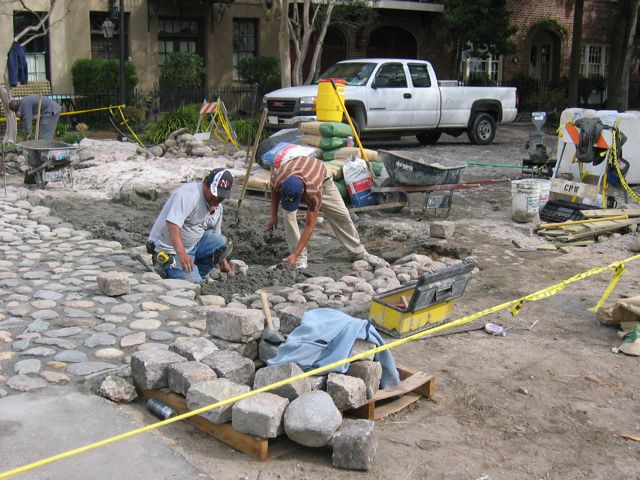
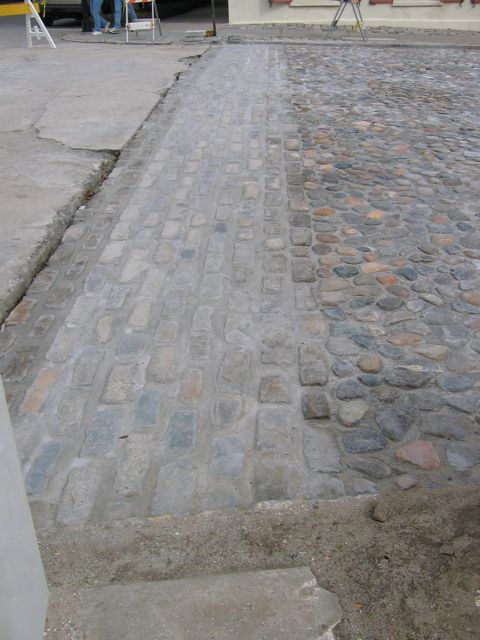
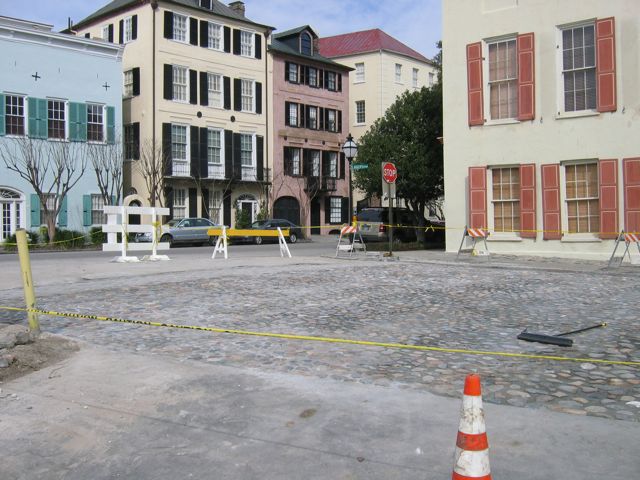
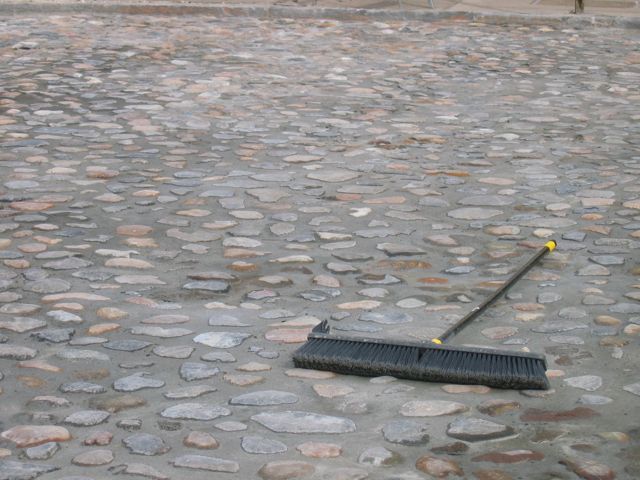
Over the past several weeks the surface of the short thoroughfare known as South Adger’s Wharf has been transformed from a patch of loose dirt to a antique-looking cobblestone street encased in concrete. The early colonial redan, uncovered in the January 2008 archaeological excavation, was re-covered with earth within hours after the dig ended. In the weeks following, the earth above the redan was compacted and leveled in order to prepare it for a “modern” street paving. Wooden forms were then laid and a thin concrete slab poured over the entire dig site. Once the concrete had cured, a crew began laying (in concrete) rows of Belgian blocks along the intersection of East Bay Street and South Adger’s Wharf. After that task was completed, palettes of odd-shaped ballast stones, the “original” (really early-twentieth-century) street surface material, were brought to the site from a storage facility. As with the Belgian blocks, the crew also used concrete to set these stones in place. While the resulting street surface now has an attractive appearance and stable foundation, the extensive (if not excessive) use of concrete does not accurately reflect the “historical” character of South Adger’s Wharf’ and has effectively entombed the old redan against future exploration.

The following photos illustrate the chronological progress of the repaving of South Adger’s Wharf, from February 5th through the 21st.

cobblestones_01.jpgcobblestones_02.jpgcobblestones_03.jpgcobblestones_04.jpgcobblestones_05.jpgcobblestones_06.jpgcobblestones_07.jpgcobblestones_08.jpgcobblestones_09.jpgcobblestones_10.jpg

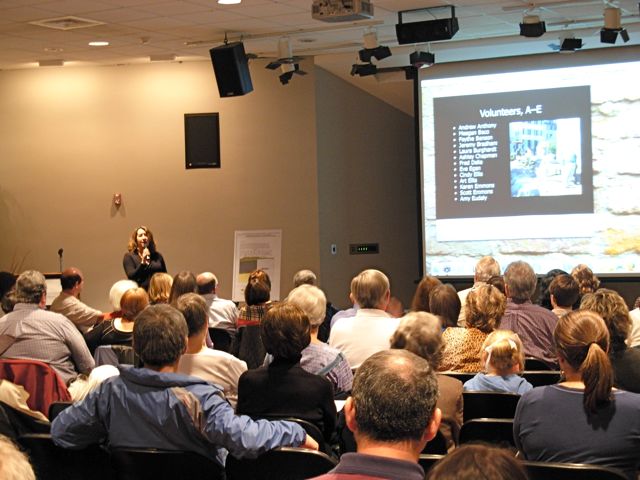
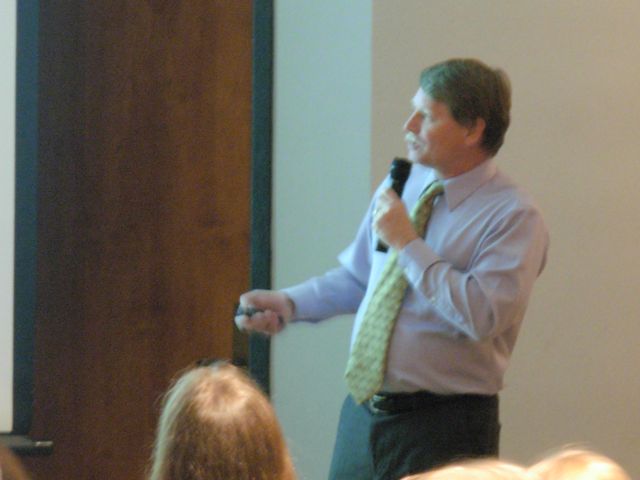
On 30 January 2008 the Mayor’s Walled City Task Force presented an illustrated overview of the recent archaeology at South Adger’s Wharf. Well over a hundred people came to the Charleston County Public Library’s auditorium to hear about the dig from several of the participants.

katherine_saunders.jpgTo open the program, Task Force co-chair Katherine Saunders took a few minutes to acknowledge the sponsors who made the archaeology possible and the volunteers who contributed so much to its success. Without the assistance and enthusiasm of these dozens of people, this long-anticipated project might never have come to fruition.

nic_butler.jpgNext, I presented an illustrated historical overview of the redan and Lower Market that once stood at the east end of Tradd Street. As you can see in the photo here, I also mentioned the building known as the Court Room and Exchange that stood just within the redan between 1723 and 1740. We were hoping to find the foundations building, but our dig site turned out to be about twenty feet north of that structure.

eric_poplin.jpgArchaeologist Dr. Eric Poplin provided a great illustrated summary of the dig, with special emphasis on reading the layers of soil that we encountered. In the brief period of time since the dig concluded, Dr. Poplin had already prepared some fascinating illustrations of the stratigraphy. His color slides, and the accompanying posters created by the History Workshop, will be included in the final published report of the South Adger’s Wharf dig.

martha_zierden.jpgCharleston Museum curator of archaeology Martha Zierden took the stage to discuss the collection and curation of artifacts from the recent dig. In addition to her slides and narration, Zierden and her colleague Ron Anthony brought a large number of pottery sherds, bone fragments, and other materials collected from the site. At the conclusion of the program, audience members were invited to crowd around the display table of artifacts and chat with the archaeologists.

peter_mcgee.jpgTo conclude the program, Task Force co-chair Peter McGee extended his thanks to everyone involved for their support and hard work, and to the audience for their attention and encouragement. The recent South Adger’s Wharf dig, which uncovered about one-third of the Tradd Street redan, was so successful, Mr. McGee opined, that he hopes the Mayor’s Walled City Task Force will be able to continue its momentum in the coming year and gather support for another dig to uncover the other two-thirds of that redan. I second that proposition!

Those of you who were unable to attend this program will be pleased to know that I am currently working on a multimedia encapsulation of this program. The finished product will be made available through this website, most likely as a podcast that can be streamed over the internet or downloaded. Stay tuned for further information!

It’s been more than week since the conclusion of the archaeological dig at South Adger’s Wharf, but we’re still not finished with this story. There are several developments that I’d like to bring to everyone’s attention.

First, the Charleston Post and Courier has just published a long editorial piece written by the co-chairs of the Mayor’s Walled City Task Force, Joseph H. McGee and Katherine Saunders, “Walled City Task Force Hopes to Continue Excavations.” This article provides the public with a good overview of the history and goals of the Task Force, and succinctly explains the significance of the recent archaeology at South Adger’s Wharf. Such media exposure is undoubtedly a boon to our efforts.

saw_post-dig.jpg Second, the dig site at South Adger’s Wharf now looks exactly like it did the day before we started our recent excavations (see “Archaeology Begins Tomorrow“). The laborious task of replacing the cobblestones will begin any day now, but in the meantime it’s a bittersweet experience to walk past the now-vacant site, as I have done several times in the past few days.

Third, I want to remind everyone that the Walled City Task Force will be presenting a public program at the Charleston County Public Library on Wednesday, January 30th, at 7:00 p.m. We’ll provide a historical overview of the redan and the Lower Market that once occupied the land at South Adger’s Wharf, and archaeologists Martha Zierden and Eric Poplin will be on hand to explain what was found.

riley_visit_last_day.jpgWednesday was an overcast, chilly day at South Adger’s Wharf, and in the late afternoon we all said a bittersweet goodbye to the redan wall that we’ve come to know so well over the past two weeks. Charleston Mayor Joseph P. Riley Jr. paid another visit to the site today and expressed to Katherine Saunders his great satisfaction with our discoveries and the enthusiastic public attention the dig has garnered. Beyond this executive visit, most of the day was spent wrapping up loose ends—measuring, surveying, sketching, and photographing. Nevertheless, we still managed to make a few very exciting discoveries.

redan_transition_1.jpgredan_transition_2.jpgredan_transition_3.jpg Several of us took turns shoveling out the slurry of mud in front of the redan’s northeastern face. Despite working right at the water table, we were determined to get a better view of the point where the outer face of the wall makes a transition from five feet wide with a sloped face to three and a half feet wide with no slope. After a couple of hours, we had removed enough of the ballast stones and brick rubble to reveal the outline of the transition, which you can clearly see in the photos here. Although the grey brick drain slices right through the middle of our exposed redan wall, you can see that the five-foot wide wall makes a ninety degree turn, then goes west for 1.5 feet, then makes another ninety degree turn towards the northwest. The lowest courses of this brick transition are still present, but unfortunately the upper courses have been demolished. Although it’s not visible here, the wall continues downward, with an outward slope, for several more feet below the water line in these photos. We weren’t able to get all the way to the foundation, but we have enough data to create some good three-dimensional images in the future.

redan_fragment_removal.jpgThanks to the well-skilled backhoe crew from Charleston Water System, several large fragments of the redan’s uppermost or parapet walls were pulled out of the dirt for safekeeping. These fragments, which were knocked into the mud during the redan’s demolition ca. 1785, can be useful teaching tools in the future, and they will certainly help us to create a visual reconstruction of Charleston colonial fortifications. The Charleston Museum will receive one or two large pieces for potential display, and one will be at the Historic Charleston Foundation.

Until today, two of the large fragments of the redan wall were lodged in the earth just in front of the redan’s northern flank, blocking our view of that five-feet-wide sloping face. Once they were removed, however, we finally had a chance to trowel away the dirt from the exposed brick face. mortise_in_redan.jpgWithin a few minutes, we discovered another small square cavity in the outer face, almost identical to the two cavities found earlier in the northwestern-most part of the exposed redan. Doug Scott, a master mason visiting the site, said he’s encountered these sorts of cavities in other colonial-era buildings in Charleston. He confirmed what we’ve suspected all along–that these cavities are mortises for wooden scaffolding used by bricklayers during the construction of the redan’s upper walls. After their completion, the wooden timbers inserted into the cavities would have been sawed off flush with the surface of the wall. Suspecting, then, that we might find another square cavity at the extreme southern edge of the exposed redan, we dug for a few minutes and found a fourth cavity in the wall’s outer face. The exposed portion of the redan is so small in that corner, however, that I couldn’t get a good photograph. poplin_total_station.jpgMeasuring along the exposed outer face of the redan, these square mortises are almost exactly six feet apart and roughly on the same horizontal level. The crew from Brockington and Associates recorded this and other data for their “total station” digital mapping of the site, which will help us create three-dimensional representations of all of these features in the future.

refilling_trenches_1.jpg As the winter sun sank in the sky, the call came to cease work and evacuate the trenches. The shovels and other equipment were gathered up and the crew stood back to take one last admiring look at the results of our two-week dig. refilling_trenches_2.jpgMoments later, the backhoe lurched into action and began pushing recently-removed soil back into the trenches. In what seemed like an instant (but really more like a bone-chilling couple of hours), the western end of South Adger’s Wharf began to resemble the street on which we first gathered on January 3d. The old redan is now out of sight, but for those of us who had the opportunity to witness its brief appearance, it will never be out of mind.

« Previous PageNext Page »