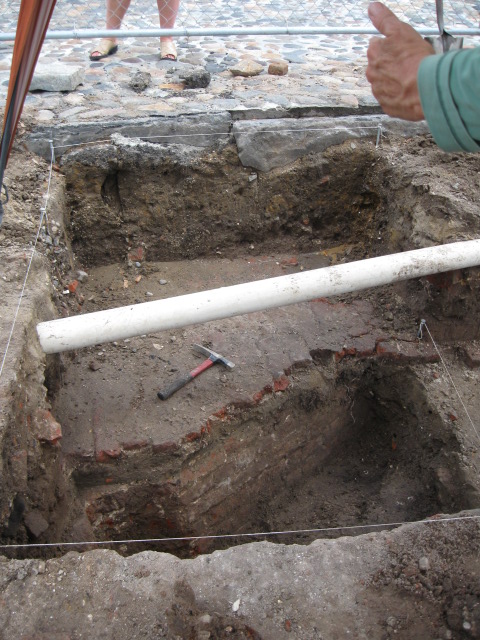
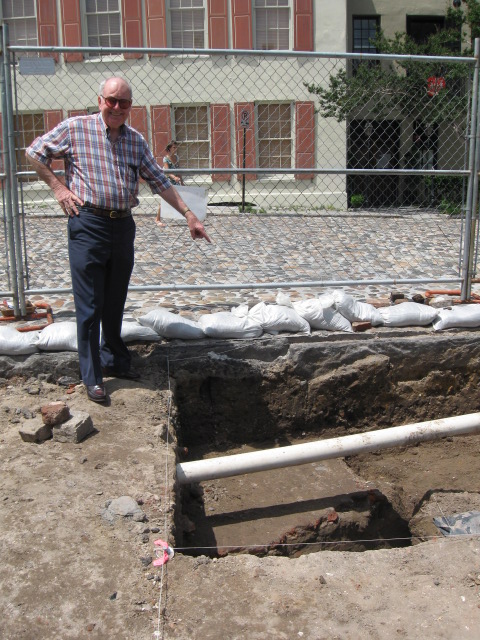
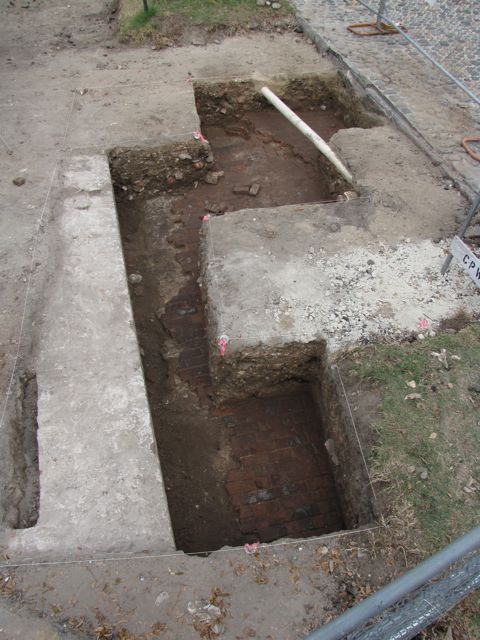
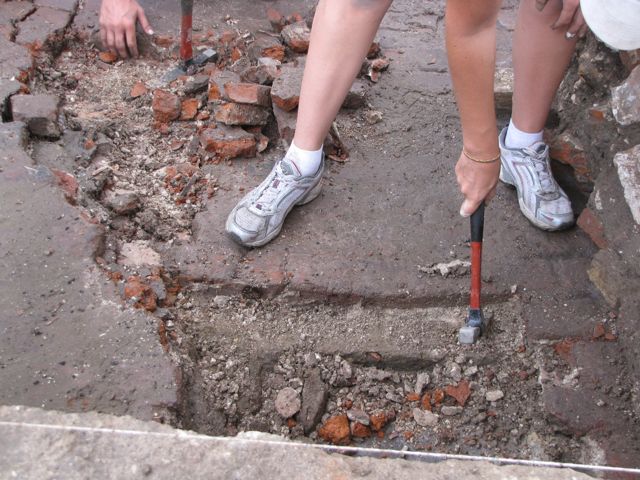
As Katherine Saunders reported on Friday, the archaeologists digging at the east end of Tradd Street have located what appears to be the apex or point of the old redan that once stood at this site. Today the College of Charleston archaeology students continued their careful excavation of the area around the old brickwork, making it a bit easier to view and understand what they’ve found.

redan_in_contextredan_apex_looking_northredan_apexredan_south_sidemarket_post_holecovering_dig_site

(Click on the images above to enlarge)

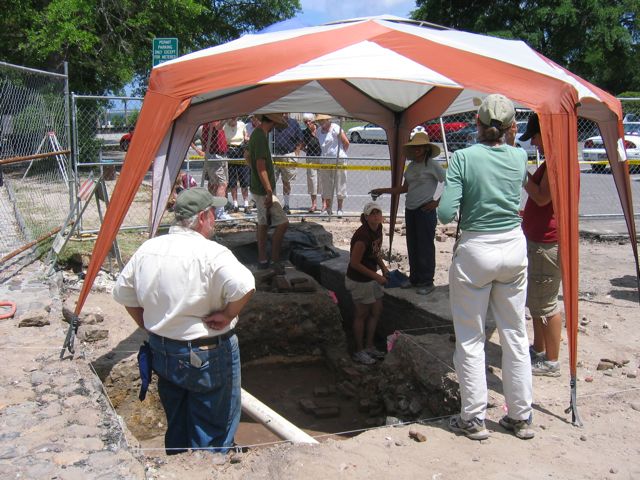
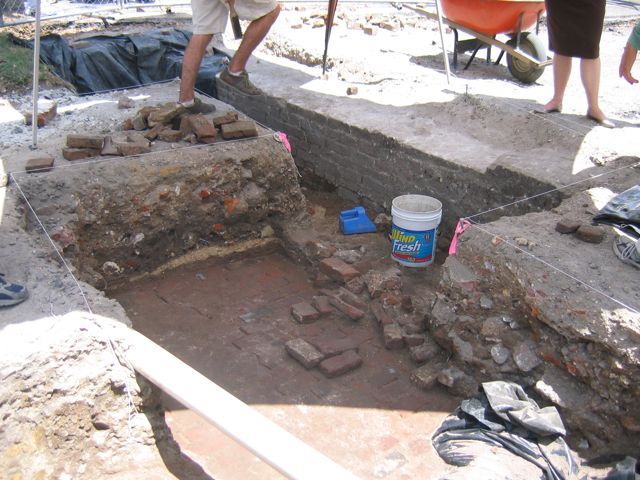
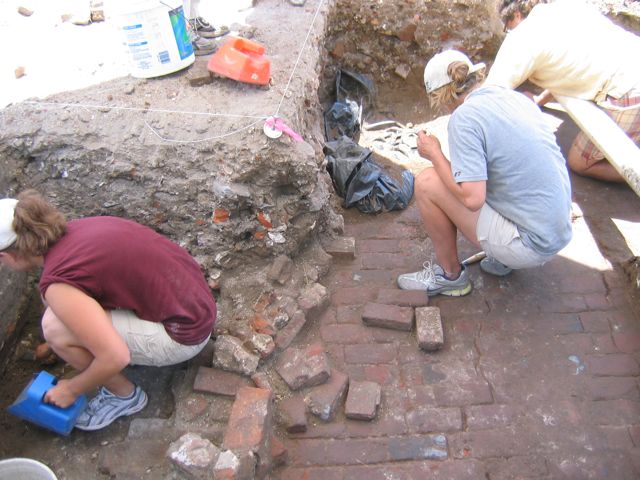
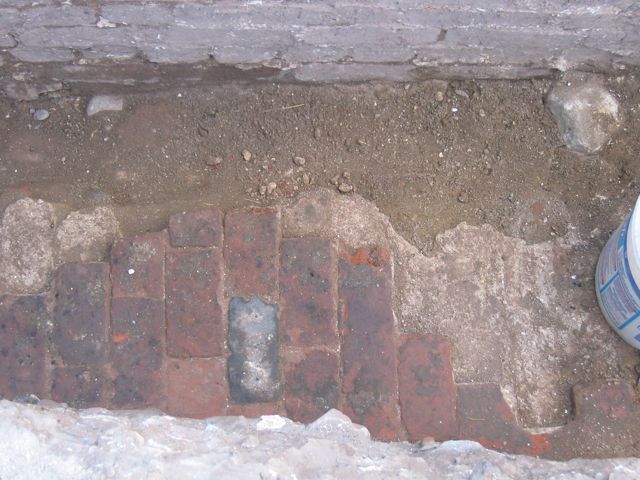
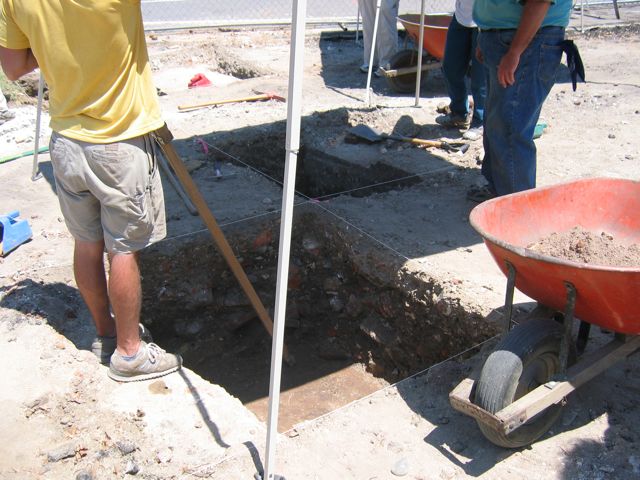
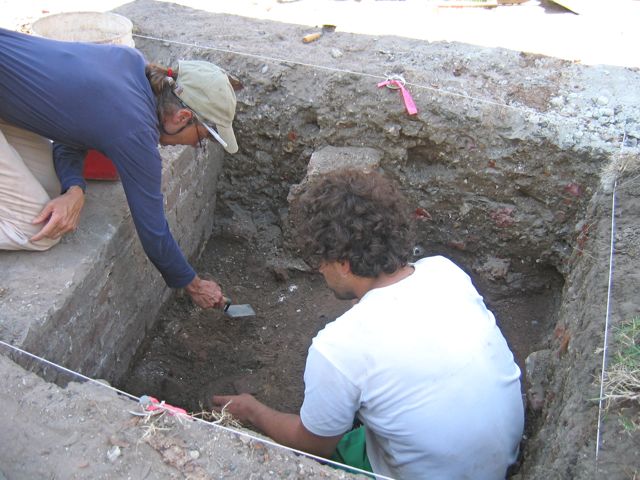
Let me guide your through the images above. Clockwise from the top left is Ron Anthony, archaeologist with the Charleston Museum and the College of Charleston, resting on his shovel just behind the apex of the redan. In the center of the top row is a side view of the apex, looking north. Note that the tip of the redan appears to project a bit beyond the “no parking” sign in the background (a useful landmark for future interpretation). The top right photograph is a close up of the remnants of the tip of the redan, and illustrates the fact that some of the superficial bricks were disturbed many years ago. The bottom left image shows the southern face of the redan near the apex. Note that the brick pavers representing the floor of the Lower Market, ca. 1786, are still present on the top of the redan. The bottom center photograph offers a close-up view of a curious feature on that south face. It appears that part of the redan brickwork was carved out in a half-cylinder shape. We saw a nearly identical feature last year when digging the north wall of this redan. In both cases, I suspect this feature represents a post hole made ca. 1786 when the Lower Market was extended over the site of the old redan. The final photograph for today shows the crew spreading the tarps over the excavation site. We’ve had a lot of rain in the past few days, and we don’t want the site to be damaged by another late-afternoon downpour.

While the crew and the members of the Mayor’s Walled City Task Force are thrilled to have located the redan, we’re a little puzzled as well. The location of the apex is not as far east as we had anticipated, thus making the overall size of the redan a little smaller than we thought. No one is disappointed, however, but this new information is causing the archaeologists to rethink the plans for the rest of the dig. Suddenly we’re chasing the wall in a slightly different direction, which means that the modern utility conduits and nineteenth-century building foundations will curtail some of the anticipated digging. Regardless of these issues, the work will continue for a few more weeks, and we look forward to some very interesting discoveries.
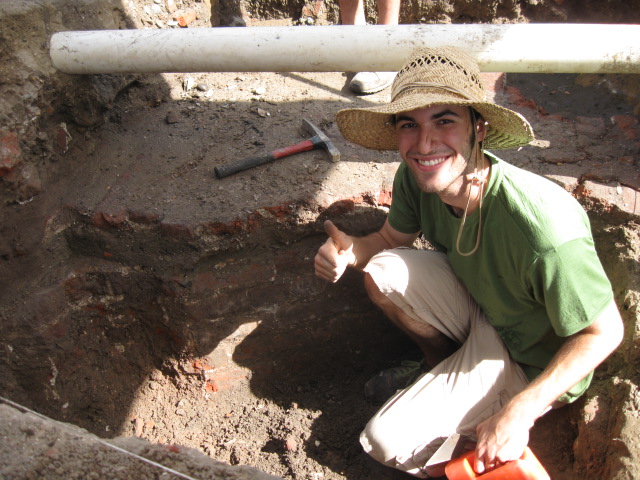
Thumbs up!

Thumbs up!

Success!  Day five was noteworthy for our first glimpse of the redan!  This exciting discovery prompted camera crews from Channel 5 and Channel 4 to come to the site today—be sure to watch the evening news tonight!

The big news came this morning when archaeologists digging in a unit directly adjacent to South Adger’s Wharf came across a portion of angled brick wall.  We’ve identified this as the outer wall of the redan’s south face.

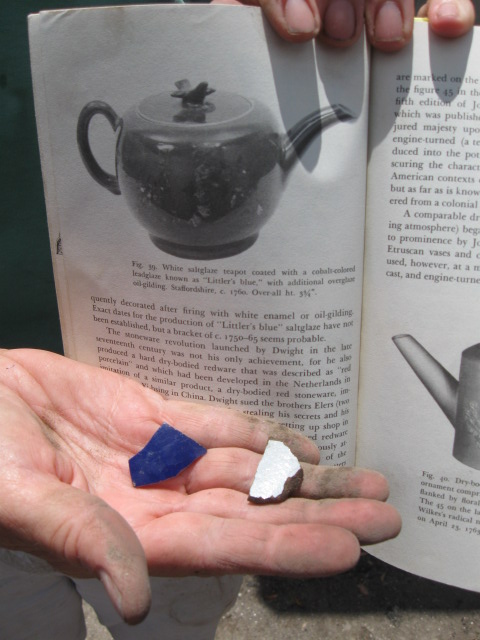
Rare ceramic find

Rare ceramic find

The redan was found directly underneath the brick market pavers that were put in place 1784 and 1786.  In 1784, the South Carolina Gazette reported on several recommendations for the city including a recommendation “that the market called the Lower Market, be immediately paved, as in its present situation, it is extremely offensive and disagreeable to the inhabitants, and others who resort there.”   After mapping and photographing the pavers yesterday and today, the archaeologists have carefully removed many of them.  This will continue on Monday as we continue to trace more of the redan’s south face.

The brick redan

The brick redan

The location of the south redan face in the area of the parking lot closest to S. Adger’s Wharf is good news.  It seems possible that the builders of Vanderhorst’s north tenement may have built that structure adjacent to the brick remains of the redan, rather than directly on top of it.  It’s also good news because we may be better able to interpret this feature to the public in the future without disrupting much of the city’s parking lot.  Depending on where the rest of the redan wall is located and how much remains, we may be able to explore the possibility of “glassing-over” the brickwork, or, at least, somehow marking the outline of the redan.

Walled City Co-Chair Peter McGee checks out the redan

Walled City Co-Chair Peter McGee checks out the redan

Monday’s digging should reveal more of the redan—be sure to stop by the site if you can and stay tuned!

The big goal for today was to get a complete record of the exposed portions of the brick floor of the Lower Market, laid ca. 1786, before the predicted rainstorm arrived. After giving the units a thorough sweeping, the College of Charleston archaeology students and their instructors began the meticulous process of measuring, sketching, and photographing the exposed features.

recording_dataopen_unitsmarket_floor_cracked

(click on the images to enlarge)

Just as this work was wrapping up, the first band of heavy rain blew in. A few minutes later, however, the rain dissipated and the work resumed. The second task was to carefully remove the brick pavers of the market floor. These thin bricks, which were originally laid in mortar, came out rather easily using shovels and small hammers. We are confident that the redan wall will be found just a few inches below the market floor, and are eager to get to it. By the time the brick pavers had been removed, however, the rain returned with a vengeance. The students quickly covered the dig site with large tarps to protect the excavation and packed up for the day.

market_floor_removalunder_market_floorrained_out

(click on the images to enlarge)

pipe_bowlpipe_stamp

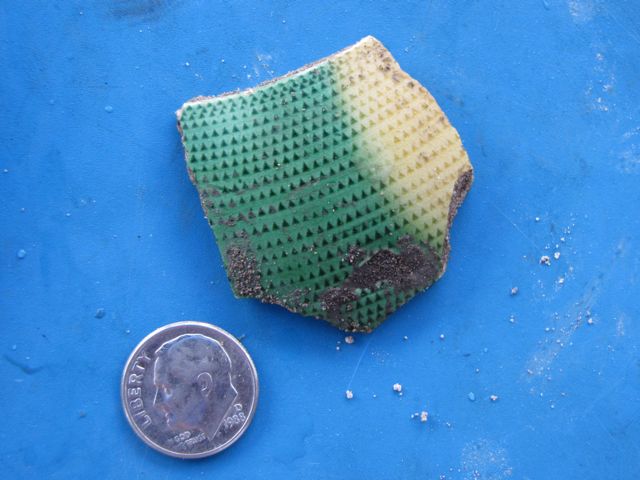
Despite the inclement weather, the students did manage to locate a few interesting artifacts. One noteworthy item is a nearly intact clay pipe bowl. Fragments of these disposable smoking implements are commonly found at eighteenth-century sites like ours, but it is rare to find an intact bowl. The maker’s stamp, “T. D.”, is even visible on this one. whielden_wareAnother interesting find is a fragment of a piece of green Whieldon ware, a type of English ceramic dating from the era 1750–1775. It’s only a small fragment of a larger vessel, but it is a vivid reminder of the colorful utensils that were used in early Charleston. Both of these artifacts, by the way, were found in the thin layer of dirt immediately below the floor of the Lower Market, which was paved over ca. 1784–1786.

It was another sultry, hot day at the east end of Tradd Street in Charleston. Despite the heat, the College of Charleston students performing this excavation opened a few more square units and quickly dug them down to the level of the existing units. After a bit of whisking with a small broom, the result of their labor was a clearer picture of the stratigraphy of the site.

site_viewopen_unitsmarket_floor

(click on the images to enlarge)

The main achievement of the day was revealing a much clearer view of the brick pavers that constitute the floor of the Lower Market, installed ca. 1784–1786. There is a clear layer of intact paving bricks throughout the open units. The bricks disturbed by later construction are seen strewn throughout the layer just above the market floor as well.

So, where is the redan? We still believe that it is directly below the bricks of the market floor, but the archaeologists wanted to clean, measure, document, and photograph the market brickwork before removing these features. A good example of these layers can be seen in this photograph. builders_trenchAt the top of the photo is the brickwork of the foundation of Vanderhorst’s North Row, a large tenement constructed on this site ca. 1805. Just below that is an area of disturbed earth that represents the builder’s trench opened during the construction of that foundation. In the middle area of the photograph can be seen the brick pavers of the market, and the whitish bed  of mortar on which those bricks rest. The top of the redan wall, we believe, will be found immediately below that mortar.

Rain is in the forcast for Thursday, but we hope it will come later enough in the afternoon to permit the students to begin removing the market floor and thus reveal the top of the colonial-era redan.

The front page of today’s edition of the Charleston Post and Courier included a very good article about the dig, written by architectural columnist, Robert Behre. A lot of Charlestonians and tourists read the article, Wall to Wall Dig, and visited the site to have a look at the work. While there may not be much to see yet, the crew is very pleased with the results so far. After two days of hand digging, the College of Charleston students have excavated three square units to a depth of nearly three feet, and have reached what appears to be the top of the remnants of the colonial-era redan and the floor of the Lower Market.

two_unitsMartha_pointsredan_unitredan_unit_detailredan_surfacebasalt_dog

(click on the images to enlarge)

At a depth of approximately 2.5 feet, they found a number of relatively thin red brick pavers, identical to ones seen in last year’s dig, which represent the floor of the Lower Market after it was extended over the remains of the redan in 1786. Many of the pavers were disturbed during some construction two centuries ago, but some can be seen in their original horizontal position. Immediately below those brick pavers is the top of the redan wall. In the photographs above, the redan surface is the field of whitish mortar below the flat red bricks of the market floor. Because of the relatively small size of the present excavated units, it’s rather difficult to convey a sense of the location of these features. Not to worry, however, because tomorrow and in the coming days the crew will open further units and improve the view. The next few days should be very exciting.

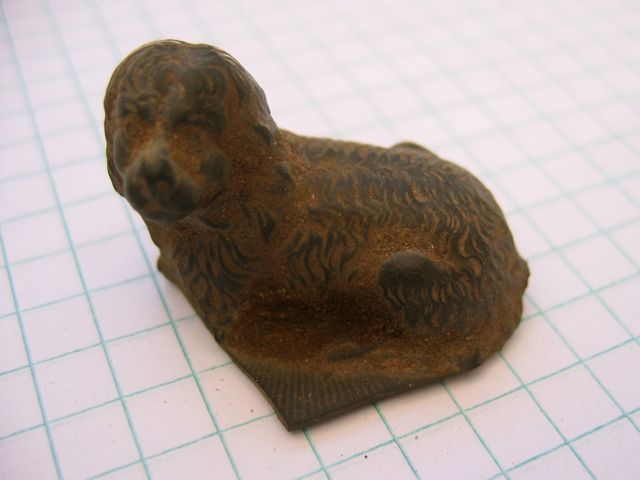
Every bit of dirt excavated from the controlled units is being screened, and the College of Charleston students are getting some valuable field experience in identifying fragments of animal bones, glassware, and a wide range of eighteenth-century ceramics. The prize find of the day, however, was a small remnant of a teapot lid, dating from the era 1760–1800. It’s made of unglazed (stained) black basalt ware, and as you can see in the photograph above, it appears to be a spaniel measuring just a few centimeters in length and height. All of the artifacts from this dig will be taken to the Charletson Museum for curation.