The Archaeological Society of South Carolina will hold its annual Fall Field Day at Charles Towne Landing State Historic Site on Saturday, 9 October 2010, from 10 a.m. to 4 p.m. That’s Tomorrow, folks! Field Day events include displays, demonstrations, lectures, artifact identification, and educational programs. It will be a fun, family friendly day, so we hope to see you there!

You can find a list of the events by following this link to the Field Day Program.

Directions to the event can be found at the website of Charles Towne Landing.

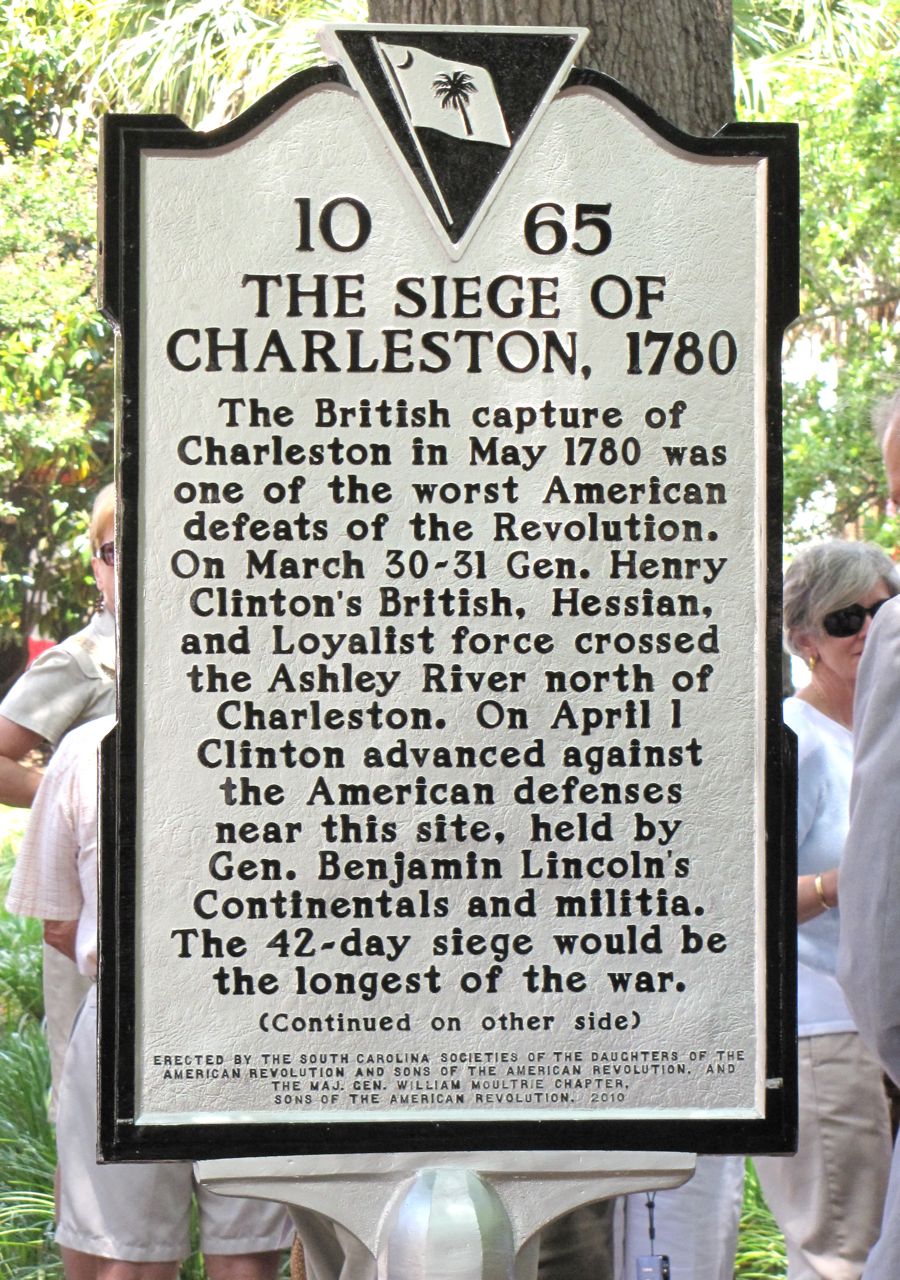
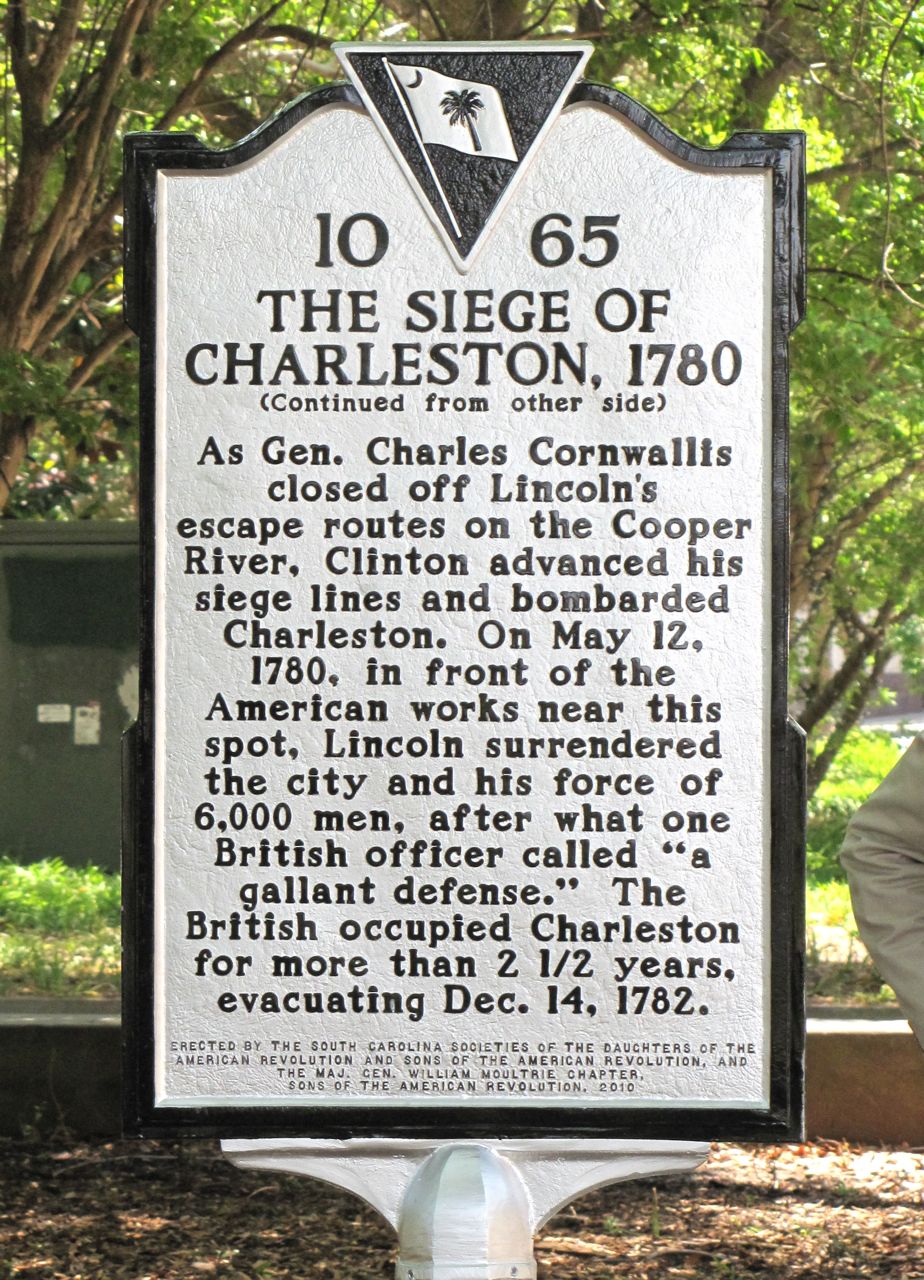
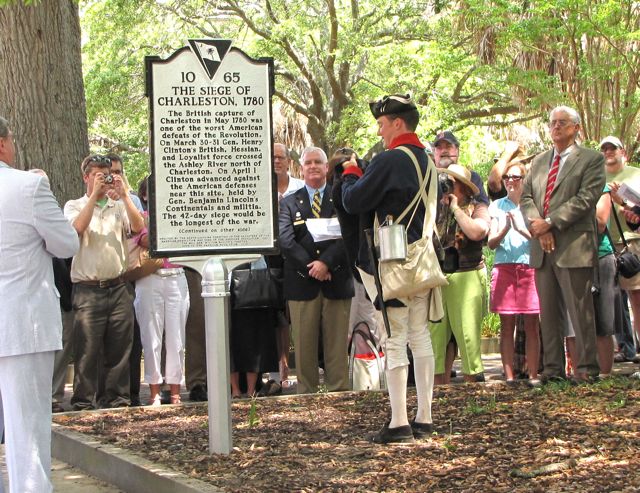
At noon today in Charleston, a crowd of more than fifty ladies and gentlemen gathered in Marion Square to witness the unveiling of a new historical marker commemorating the six-week British siege of the city in 1780 and the 230th anniversary of the surrender of Charleston.

South face of the new marker

North face of the new marker

The marker, placed at the western edge of Marion Square, next to the east side of King Street, briefly summarizes the British siege and its significance to the larger story of the American Revolution. Before today, there was no signage of any kind to acquaint passing residents and tourists with the dramatic story of the siege and the military significance of the site. For those of you who haven’t yet seen the marker, I  photographed both sides for your reading pleasure.

The west side of Marion Square represents the center of the American defensive line during that fateful siege. Between 1757 and 1759 a large tabby fortress, a “Horn Work,” was erected on the site, and it served as the gateway into the city for the next twenty-five years. Between 1776 and May 1780, the American forces also built a series of elaborate fortifications north of and on each side of the Horn Work, stretching the entire distance between the Ashley and Cooper Rivers. The British army landed on the northern neck of the Charleston peninsula at the end of March 1780 and relentlessly bombarded the American defenders as they crept southward towards these defensive works. After a six-week siege, the American forces surrendered the town to Sir Henry Clinton just after noon on the 12th of May, 1780. It was the most elaborate siege in the course of the American Revolution, and the capitulation of Charleston proved to be the largest American surrender during the war. Anyone interested in learning more about the events leading up to the surrender of Charleston on 12 May 1780 should read Carl Borick’s book, A Gallant Defense: The Siege of Charleston, 1780 (University of South Carolina Press, 2003).

Mark Maloy (center) unveils the new marker

We all owe a great debt of gratitude to Mark Maloy, who spearheaded the campaign to erect the marker and coordinated the group effort to draft its text. Over the course of about seventeen months, Mark brought together a number of organizations that endorsed and helped bring the project to fruition, including the Maj. Gen. William Moultrie Chapter of the Sons of the American Revolution, the South Carolina Society of the Sons of the American Revolution, the South Carolina Society of the National Society of the Daughters of the American Revolution, the Washington Light Infantry/Sumter Guards Board of Officers, the City of Charleston, the South Carolina Department of Archives and History, and Sewah Studios. Hats off to Mark and all the supporters–Huzzah!

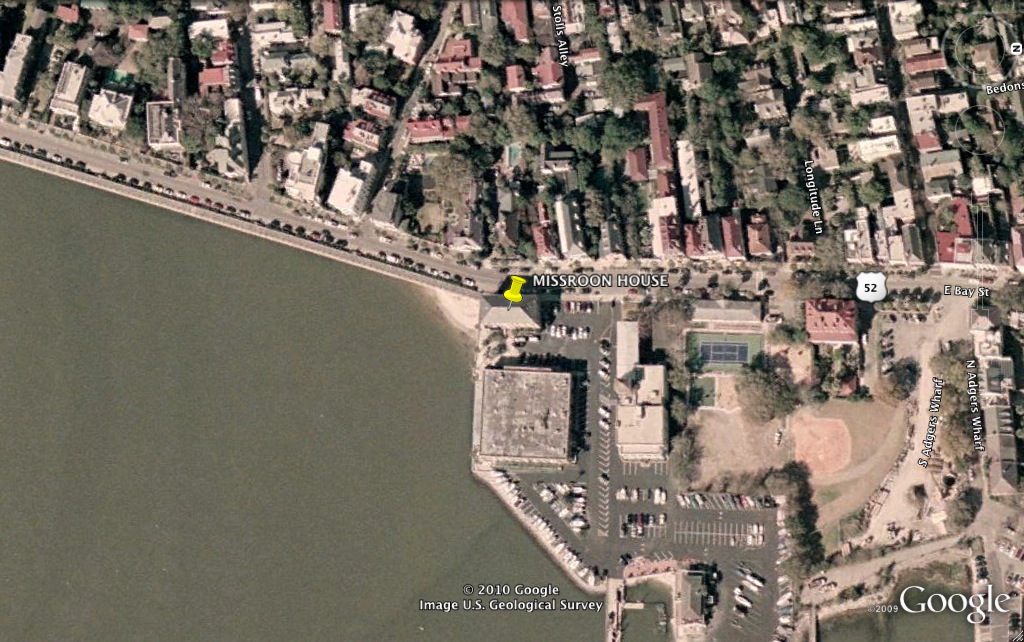
Missroon House (center)

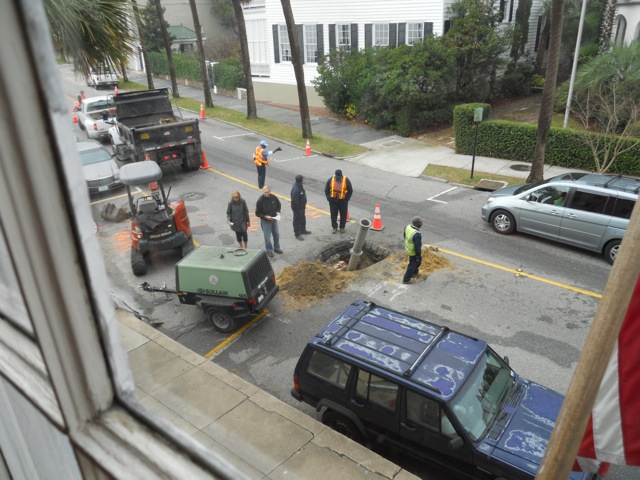
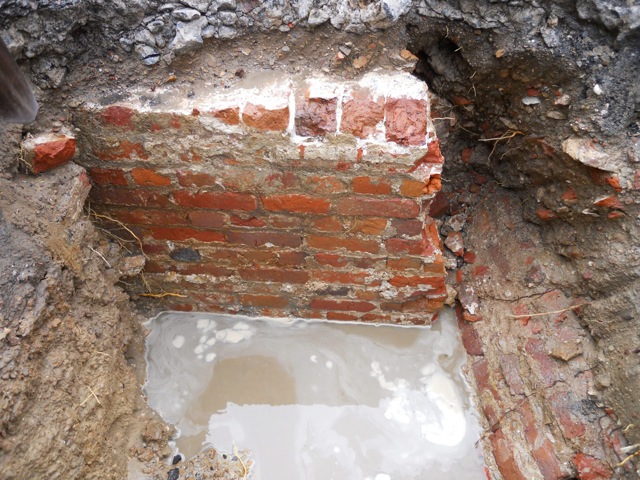
On 21 December 2009, a City of Charleston’s stormwater drainage crew parked next to the Missroon House, No. 40 East Bay Street, to address a routine problem. Their equipment had detected a subterranean leak in the main drain running down the center of East Bay Street, near the point where East Bay Street becomes East Battery Street. After opening a small hole in the asphalt road surface, the work crew dug a few feet down and found the leak in the old nineteenth-century brick arched drain. In the process, they also uncovered a small portion of the south wall of Granville Bastion.


Walled City Task Force co-chair Katherine Saunders was right on the spot since the Missroon House, the home of the Historic Charleston Foundation, literally sits directly on top of the eastern portion of Granville Bastion. With her iPhone, she snapped a few photographs to document both the location and the materials. As you can see in the photos below, the nineteenth-century drain, constructed of grayish bricks on the right, intersects the bright reddish-orange bricks of the colonial bastion. The Task Force encountered a very similar phenomenon while digging at South Adger’s Wharf in January 2008. In both cases, the colonial brickwork was excised just enough to make room for the drain

Granville Bastion was the first and the largest of Charleston’s brick bastions, commissioned by an act of the legislature in late 1696. During the early years of the eighteenth century it was frequently called simply “the Fort” because of its size and its importance to the town’s waterfront defenses. It was here that each of the colonial governors was formally welcomed, and the birthdays of the king and queen of England were publicly toasted.

While this brief sighting on 21 December 2009 did not include any exploratory digging or archaeological investigation, it did provide valuable confirmation that substantial remnants of Granville Bastion survive under the roadbed of modern East Bay Street. A substantial portion of southeast corner of Granville Bastion is exposed under the foundation of the Missroon House, several yards east of the street, but that area is not easily accessible and is not open to the public. For the time being, the remnants of Charleston’s first brick “fort” lie safely hidden beneath the modern hardscape, invisible to the throngs of tourists walking along the High Battery along Charleston’s picturesque waterfront.

Sometime after the creation of the Mayor’s Walled City Task Force in the summer of 2005, I set a research goal for myself. If one were going to write a proper history of urban Charleston’s colonial fortifications, I thought, one should read through all the surviving legislative records from that era. Since the City of Charleston was not incorporated until 1783, there was no City Council during the colonial era, and thus the duty of building, maintaining, and dismantling the urban fortifications was performed by the provincial legislature.  More specifically, the Commons House of Assembly, the forerunner of the modern state House of Representatives, did the bulk of the legislative work. Since the “Commons” administered the disbursement of money from the treasury (through the Public Treasurer or Receiver, of course), the surviving journals of the Commons House contain more evidence of the rise and fall of the “Walled City” than any other source.

We are fortunate that nearly all of the handwritten journals of South Carolina’s Commons House of Assembly—dozens of leather-bound volumes spanning the years from 1692 to 1775—have survived into the twenty-first century. There are a few small gaps here and there, of course, and unfortunately the most egregious lacuna is the missing journal of 1718–1719. In that long-lost journal would be the records of the trial of the pirate Stede Bonnet and his crew as well as the records of the bloodless Revolution of December 1719. All of the surviving Commons House journals can be found at the South Carolina Department of Archives and History (SCDAH) in Columbia. Approximately one half of these journals have been published (see the Selected Bibliography page), but the rest are accessible only at SCDAH.

After nearly four years of work, I am proud to announce that I have now read through all of the surviving journals of the South Carolina Commons House of Assembly, 1692–1775, and transcribed all of the materials therein relating to the urban fortifications of colonial Charleston. Along the way I lost track of how many volumes and pages I had read, but I can say with confidence that this task involved tens of thousands of pages of rather dreary legislative proceedings. From this work I have amassed more than 400,000 words of raw notes ( typed into my trusty Apple laptop) relating to Charleston’s fortifications. Adding in materials transcribed from other primary sources (mostly colonial statutes and Journals of the South Carolina House of Representatives, 1776–1794), I now have approximately 500,000 words of raw notes.

So what’s next on the research front of this Task Force? Now I’m now reading through all of the surviving journals of the His Majesty’s Council for the Province of South Carolina, 1721–1775. This branch of the colonial legislature served as a sort of “privy council” for the governor, advising him on various projects and policies. While the journals of the Council are not as numerous as those of the Commons, they do contain some unique information relating to the fortifications of urban Charleston. So far I’ve read through these journals up to 1743, and I hope to complete this task by the end of 2010.

From all of this evidence derived from primary sources, a book-length treatment of the history of Charleston’s colonial fortifications will eventually be distilled. I promise.

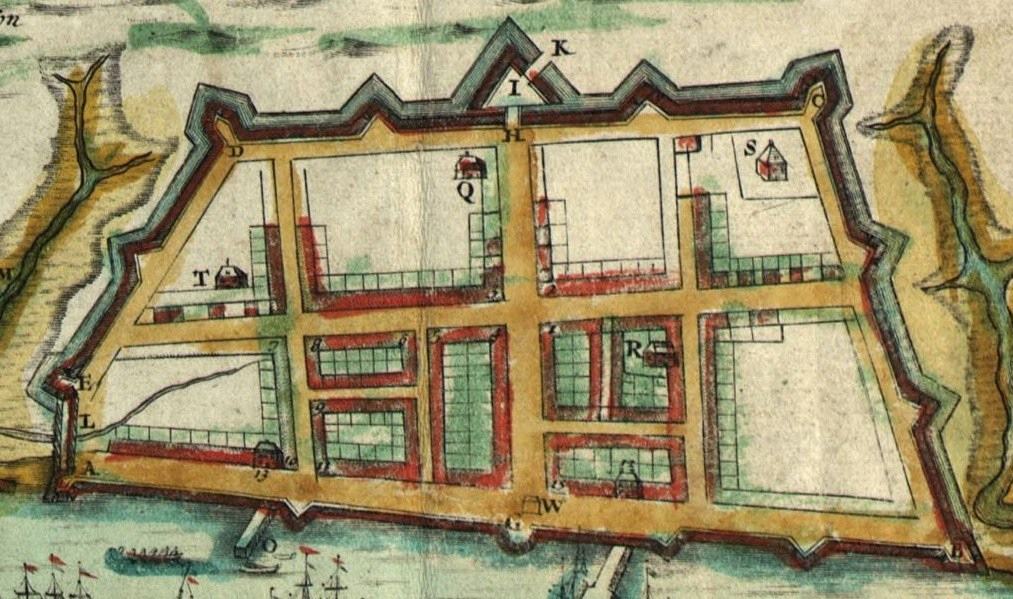
Recently I’ve been asked about the names of the streets illustrated in the “Crisp Map” of 1711. This map, published in London in 1711, depicts the small urban settlement of Charles Town confined within a system of walls. A number of features in the town are marked with letters or numbers and identified in an accompanying “Explanation” or key. Unfortunately, the names of the streets are not included in this key. By referring to other contemporary documents, however, we can identify the street names with some confidence.

When the “Crisp Map” was published in 1711, the South Carolina legislature had not yet legally confirmed the names of any of the streets in Charles Town. In 1722–23, during the short-lived incorporation of what was known as “Charles City and Port,” the provincial legislature contemplated the official naming of the streets as part of a complete re-survey of the town. The British Parliament disallowed the incorporation of Charles Town, however, and the matter was dropped. Again during the mid-1730s, the South Carolina legislature ordered a re-survey of the town and in 1736 attempted to pass an act to confirm the names of the streets. This measure failed, but in a separate act the name of Dock Street was legally changed to Queen Street. By the middle of the eighteenth century, the remaining street names of Charles Town had become so well established by common usage that they resisted change. Only after the incorporation of the city of Charleston in 1783 did the municipal government regard street names as fixed titles that required legislation to alter.

In the absence of “official” street names in 1711, therefore, the streets of Charles Town were designated by fairly flexible system of nomenclature. The street along the waterfront of the Cooper River, for example, was commonly called “the Bay” or “the Bay street” or “Front Street.”  Today it’s called East Bay Street, but that name doesn’t become common until the mid-1700s. The broad central thoroughfare perpendicular to the river was originally designated “Cooper Street,” in honor of Lord Anthony Ashley Cooper, the first Earl of Shaftesbury, but the descriptive name “Broad Street” has endured in common usage for more than three hundred years. Several early legislative records mention “South Street” and “North Street” as the other two principal thoroughfares in early Charles Town. These names were occasionally used to designate the two streets parallel to Broad Street, which we now call Tradd Street (south of Broad) and Queen Street (north of Broad).

The surviving records of the early granting and conveying of town lots in urban Charles Town contain many references to streets. From these records, which date back to the 1680s, we learn that street names were most frequently determined by prominent landmarks along their path. The “South Street” perpendicular to the Cooper River, running past the house of Richard Tradd, was commonly called “Mr. Tradd’s Street” (today’s Tradd Street). Similarly, the “North Street” ran past Edward Loughton’s dock (built in 1706) near the bay and was best known as Dock Street (today’s Queen Street). The Street that ran past the Anglican church was called “Church Street” until the church moved in the 1720s. At that time the street in front of the new Church became “New Church Street” (today’s Church Street), and the street by the old church became “Old Church Street” Since the mid-1700s, however, Old Church Street has been more commonly called “Meeting Street” because its path also ran past the Meeting House of the Independent Congregational Church.
Detail from the 1711 "Crisp Map" of Charles Town

Detail from the 1711 “Crisp Map” of Charles Town (click to enlarge)

So what are the names of the streets depicted in the “Crisp Map”? The street fronting the Cooper River is “the Bay” or “Bay Street,” today called East Bay Street, leading from Granville’s Bastion (letter “A” on the map) to Craven’s Bastion (letter “B”). The central street perpendicular to the Bay Street is Broad Street, which leads from the Half Moon Battery and Watch House (letters “G” and “W”) to the town gate (letter “H”). The street leading from Carteret’s Bastion (letter “C”) to Colleton Bastion (letter “D”) was called “Church Street” until the early 1720s, and afterward called “Old Church Street” and then “Meeting Street.” The central street parallel to East Bay Street and Meeting Street did not officially have a name when Crisp published this map, but in the early 1720s it became known as New Church Street, and is now simply called Church Street. The street parallel to and immediately south (left) of Broad Street is Tradd Street, while the street parallel to and immediately north (right) of Broad Street is Queen Street. The narrow street parallel to and between Broad and Tradd Streets is Elliott Street. The narrow lane connecting Tradd and Elliott Street is Bedon’s Alley. The narrow lane connecting Broad Street and Queen Street was called Union Street after the political union of England and Scotland in 1707, but was renamed State Street in 1811. The narrow lane connecting Union Street and New Church Street was called Beresford’s Alley (now Chalmers’ Street).

Note, however, that the streets depicted at extreme south (left) and extreme north (right) of the town represent a bit of artistic license. These streets were not part of the original town plan, known as the Grand Model of Charles Town, and, if they ever truly existed, they disappeared after the earthen walls were dismantled ca. 1730.  Today’s Water Street was created from the creek depicted south (left) of the town in the Crisp Map, and today’s Cumberland Street was created in 1747 near the site of the north (right) town wall depicted in this map.