South Adger’s Wharf


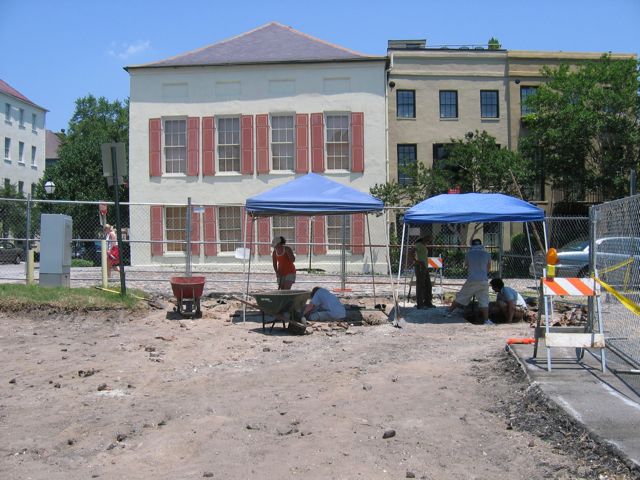
At 7:30 this hot morning, a dozen College of Charleston archaeology students began exploring the site of the colonial redan at the east end of Tradd Street in downtown Charleston. Under the tutelage of Barbara Borg, Martha Zierden, and Ron Anthony, these students will spend the next four weeks digging and sifting the soil in an effort to locate and record remnants of the old redan (ca. 1700–1785), the old Lower Market (1750–1800), and perhaps the old Exchange or Vendue House (1722–1772).

IMG_0008IMG_0036IMG_0035IMG_0029IMG_0017IMG_0030

(click on the images to enlarge)

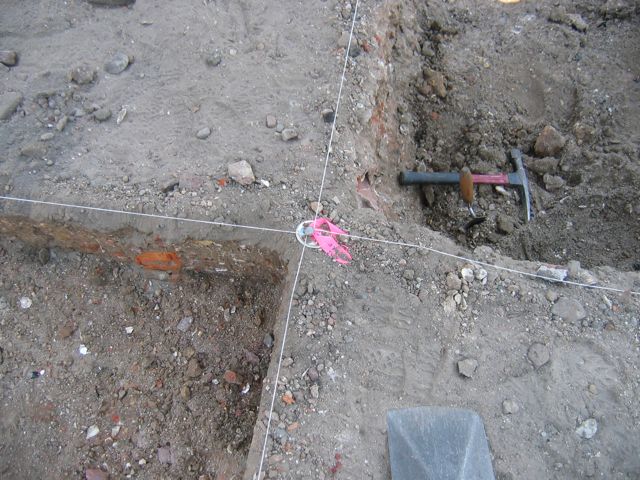
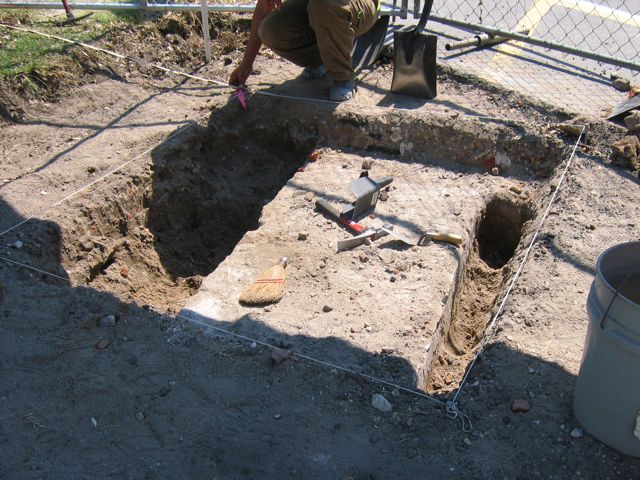
The asphalt of the city-owned parking lot was removed last Thursday, and the archaeologists established a grid for the work site on Friday. Today the students began hand digging the soil, the first two feet (approximately) of which are twentieth-century fill. Given the relatively long duration of this dig, the pace will be slower and the work more meticulous than that done in 2008. The students are digging carefully measured units, and every shovel full of dirt is being screened. A bounty of small eighteenth-century artifacts have already been found, and at least one major architectural feature is now visible: the north wall of Vanderhorst’s North Row.

Last year’s dig in the street known as South Adger’s Wharf uncovered the northern wall of the redan or “salient angle” that stood at the east end of Tradd Street from the late 1690s to the mid-1780s. In addition, we found part of the Lower Market that  stood east of the redan from the early 1750s and was extended over the redan in 1786 before being removed in 1800. After those structures were gone, the City of Charleston sold part of the land in 1804 to Arnoldus Vanderhorst, who soon afterward erected a large three-story brick tenement. That building, known as Vanderhorst’s North Row, was destroyed by the earthquake of 1886, and replaced by a large one-story warehouse that stood until the early twentieth century.
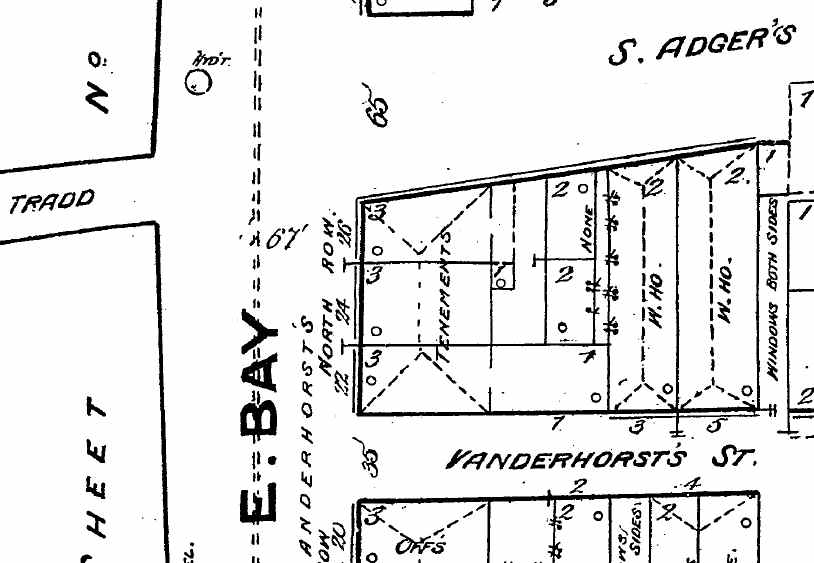
Vanderhorst's North Row (center), from the 1884 Sanborn Insurance Map

Vanderhorst's North Row (center), from the 1884 Sanborn Insurance Map

As you can see in two of the photos above, we seem to have encountered part of the northern wall of Vanderhorst’s North Row, a solid  mass of brick and mortar two feet wide. To what extent does this large architectural feature impact the remnants of the old redan? We’re hoping that the builders two hundred years ago worked around the massive brickwork of the redan, as they are know to have done at the Exchange Building and the Missroon House, which were built nearby with a few decades of each other. For better or for worse, I’m confident we’ll know the answer to this question within a few days.

The public is welcome to visit the site and watch the progress of this dig in person between 7:30 a.m. and 2:30 p.m. It’s June in Charleston, however, so if the heat is too much for you, stay tuned to this site for continued coverage.

Beginning Monday, June 1st 2009, the ground will again be opened near South Adger’s Wharf in downtown Charleston in search of the city’s colonial fortifications. Charleston Musuem Archaeologist Martha Zierden will be leading a “field school” for archaeology students who will excavate the site over four weeks in the month of June. Like all efforts of the Mayor’s Walled City Task Force, this project is a cooperative venture involving a number of agencies, including the City of Charleston, the Historic Charleston Foundation, the Charleston Museum, and the College of Charleston.

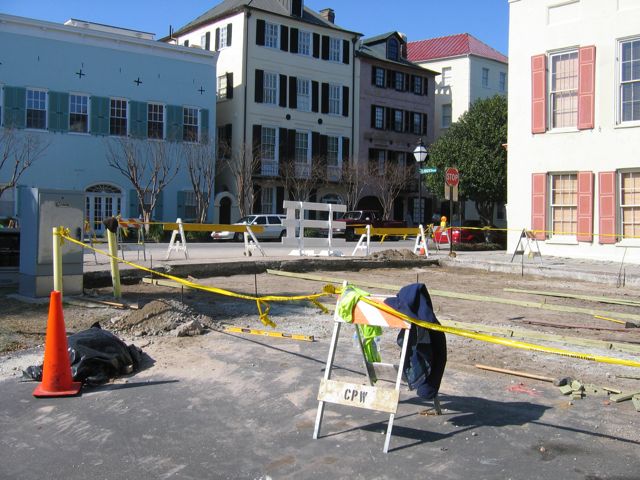
The dig site at the southeast corner of East Bay Street and South Adger's Wharf

The dig site at the southeast corner of East Bay Street and South Adger's Wharf

The upcoming work represents a continuation of the productive dig at South Adger’s Wharf in January 2008. During that ten-day excavation, the Walled City Task Force uncovered approximately 24 feet of the northern wall of the old redan at the east end of Tradd Street (see the images elsewhere on this blog). The June 2009 dig will explore the southern portion of the redan, which is under a city-owned asphalt parking lot adjacent to last year’s dig site. We hope to uncover the apex and a significant portion of the southern wall of the redan, and to explore the foundations of these brick fortifications that were begun in the late 1690s and leveled in the mid-1780s.

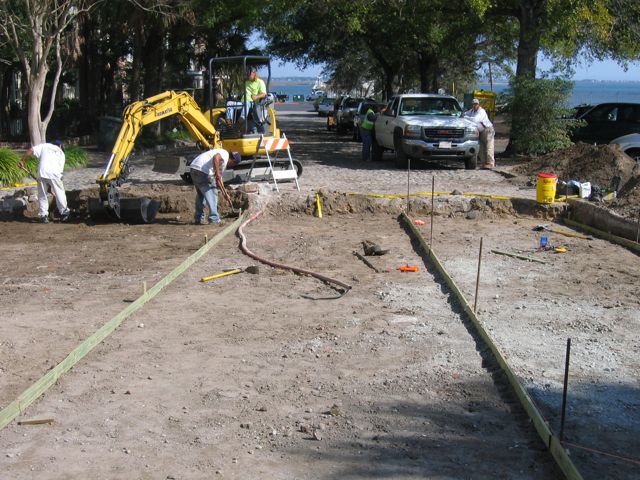
The asphalt surface of the parking lot was removed on 28 May 2009

The asphalt surface of the parking lot was removed on 28 May 2009

The public is invited to come view the work in progress on weekdays between 8:00 a.m. and 2:30 p.m. Educational posters will be displayed at the dig site for the duration, and volunteer will be on hand to answer questions during work hours. In addition, I will be blogging about the excavation as it unflolds, and hosting a wrap-up program at the Charleston County Public Library on Tuesday, June 30th, at 6:30 p.m. Stay tuned for information about the latest discoveries!

Dr. Nic Butler digging at South Adger\'s Wharf in January 2008 At noon this Friday, May 9th 2008, Dr. Nic Butler will be the featured guest on Walter Edgar’s Journal, a weekly radio program broadcast on South Carolina ETV Radio. Dr. Butler is Special Collections Manager at the Charleston County Public Library and historian for the Mayor’s Walled City Task Force. The topic of Friday’s conversation, recorded on February 18th, is the recent archaeology at South Adger’s Wharf and Charleston’s colonial fortifications in general. We’ll hear some insight into the formation of the Mayor’s Walled City Task Force and the planning and research that preceded the dig, as well as a summary of our findings and some discussion of the prospects for future archaeology of Charleston’s colonial walls. In short, it will be an inspiring conversation about one of the most unique and exciting aspects of this city’s history.

If you miss Friday’s broadcast, don’t panic! After a delay of about a week you’ll be able to download the free podcast version of the program from Dr. Edgar’s web page or from iTunes. Enjoy!

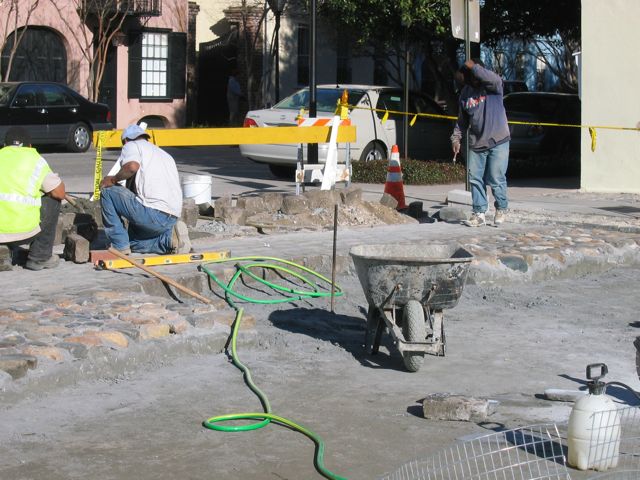
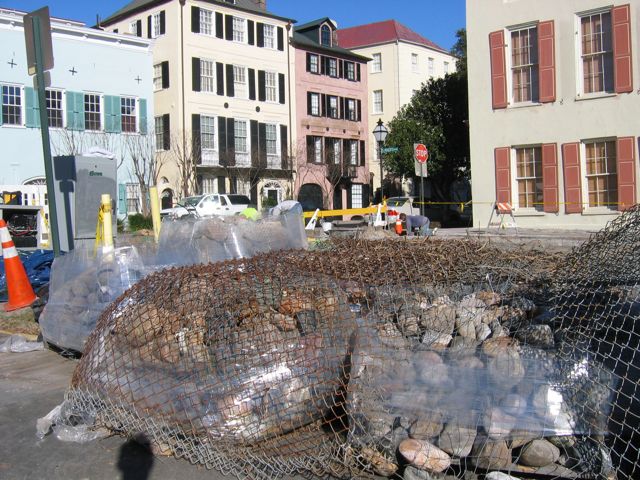
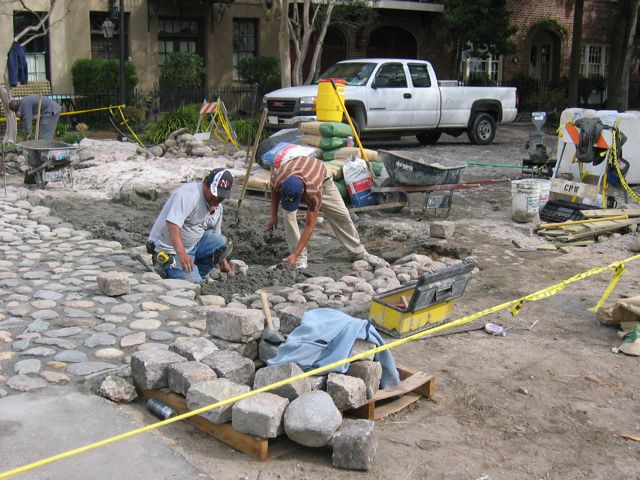
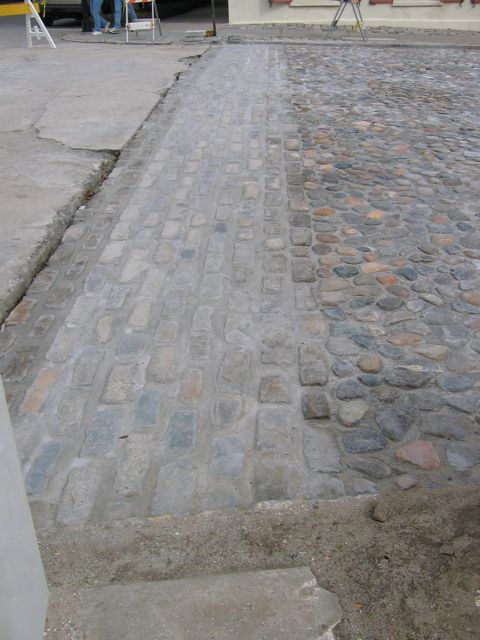
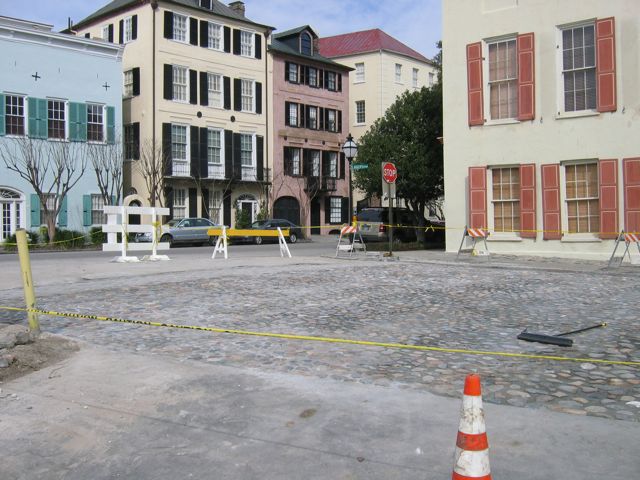
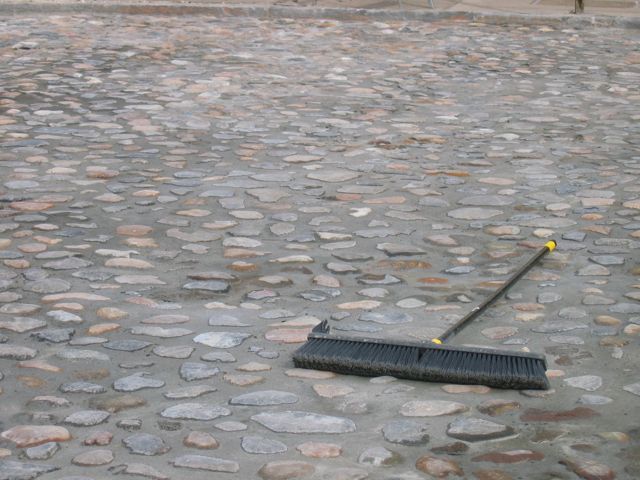
Over the past several weeks the surface of the short thoroughfare known as South Adger’s Wharf has been transformed from a patch of loose dirt to a antique-looking cobblestone street encased in concrete. The early colonial redan, uncovered in the January 2008 archaeological excavation, was re-covered with earth within hours after the dig ended. In the weeks following, the earth above the redan was compacted and leveled in order to prepare it for a “modern” street paving. Wooden forms were then laid and a thin concrete slab poured over the entire dig site. Once the concrete had cured, a crew began laying (in concrete) rows of Belgian blocks along the intersection of East Bay Street and South Adger’s Wharf. After that task was completed, palettes of odd-shaped ballast stones, the “original” (really early-twentieth-century) street surface material, were brought to the site from a storage facility. As with the Belgian blocks, the crew also used concrete to set these stones in place. While the resulting street surface now has an attractive appearance and stable foundation, the extensive (if not excessive) use of concrete does not accurately reflect the “historical” character of South Adger’s Wharf’ and has effectively entombed the old redan against future exploration.

The following photos illustrate the chronological progress of the repaving of South Adger’s Wharf, from February 5th through the 21st.

cobblestones_01.jpgcobblestones_02.jpgcobblestones_03.jpgcobblestones_04.jpgcobblestones_05.jpgcobblestones_06.jpgcobblestones_07.jpgcobblestones_08.jpgcobblestones_09.jpgcobblestones_10.jpg

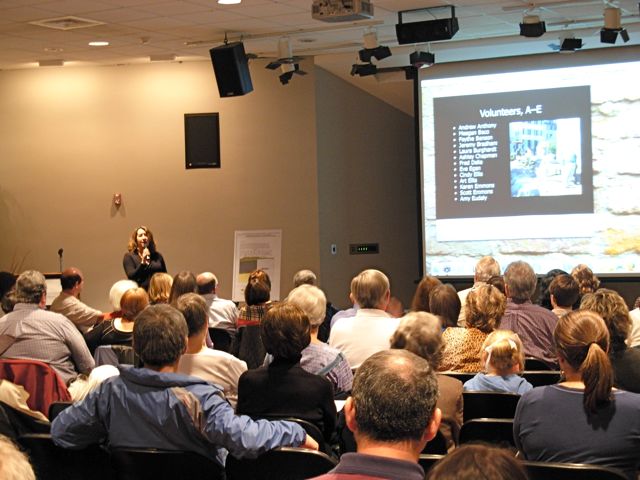
On 30 January 2008 the Mayor’s Walled City Task Force presented an illustrated overview of the recent archaeology at South Adger’s Wharf. Well over a hundred people came to the Charleston County Public Library’s auditorium to hear about the dig from several of the participants.

katherine_saunders.jpgTo open the program, Task Force co-chair Katherine Saunders took a few minutes to acknowledge the sponsors who made the archaeology possible and the volunteers who contributed so much to its success. Without the assistance and enthusiasm of these dozens of people, this long-anticipated project might never have come to fruition.

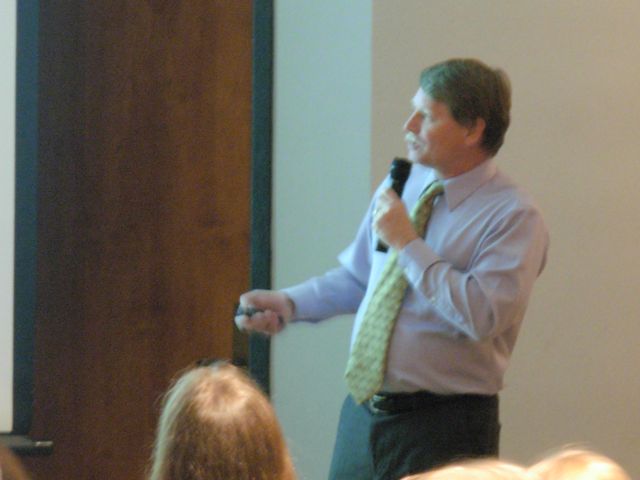
nic_butler.jpgNext, I presented an illustrated historical overview of the redan and Lower Market that once stood at the east end of Tradd Street. As you can see in the photo here, I also mentioned the building known as the Court Room and Exchange that stood just within the redan between 1723 and 1740. We were hoping to find the foundations building, but our dig site turned out to be about twenty feet north of that structure.

eric_poplin.jpgArchaeologist Dr. Eric Poplin provided a great illustrated summary of the dig, with special emphasis on reading the layers of soil that we encountered. In the brief period of time since the dig concluded, Dr. Poplin had already prepared some fascinating illustrations of the stratigraphy. His color slides, and the accompanying posters created by the History Workshop, will be included in the final published report of the South Adger’s Wharf dig.

martha_zierden.jpgCharleston Museum curator of archaeology Martha Zierden took the stage to discuss the collection and curation of artifacts from the recent dig. In addition to her slides and narration, Zierden and her colleague Ron Anthony brought a large number of pottery sherds, bone fragments, and other materials collected from the site. At the conclusion of the program, audience members were invited to crowd around the display table of artifacts and chat with the archaeologists.

peter_mcgee.jpgTo conclude the program, Task Force co-chair Peter McGee extended his thanks to everyone involved for their support and hard work, and to the audience for their attention and encouragement. The recent South Adger’s Wharf dig, which uncovered about one-third of the Tradd Street redan, was so successful, Mr. McGee opined, that he hopes the Mayor’s Walled City Task Force will be able to continue its momentum in the coming year and gather support for another dig to uncover the other two-thirds of that redan. I second that proposition!

Those of you who were unable to attend this program will be pleased to know that I am currently working on a multimedia encapsulation of this program. The finished product will be made available through this website, most likely as a podcast that can be streamed over the internet or downloaded. Stay tuned for further information!

« Previous PageNext Page »