programs


Last month’s “Walled City” program focused on one specific structure—the “Horn Work” that straddled King Street between 1757 and 1784. That large fortification served as the centerpiece of Charleston’s counterattack during the British siege of 1780, but it was just a small part of the town’s defenses. Between the autumn of 1775 and the spring of 1780, local forces erected an expansive network of fortifications that literally surrounded the town (excepting only marshes considered “impassable”). The materials used to construct these works ( including brick, tabby, palmettos, and earth) and their locations reflect the defensive strategy conceived by the American forces in anticipation of an inevitable British attack. Despite these preparations, the town’s defenses were overpowered by the British Army in May 1780, and the fortifications lingered in disrepair until the end of the war in 1783.

If you’d like to learn more about this topic, please join Dr. Nic Butler and the Walled City Task Force for an illustrated survey titled

“Charleston’s Fortifications of the American Revolution, 1775-1783”

Time: Monday, November 25th at 6:00 p.m.

Place: Second Floor Classroom, Charleston County Public Library, 68 Calhoun St., 29401.
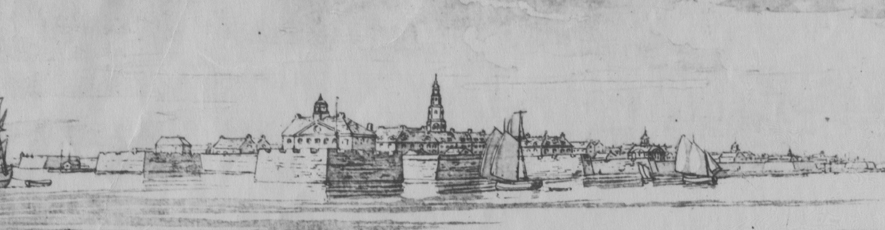
Detail from a 1777 map of Charleston harbor

Detail from a 1777 map of Charleston harbor

Ever wondered about the story behind that slab of tabby standing inside an iron fence in Marion Square? Well, you’re not alone. For Charlestonians and tourists alike, that curious mass of oyster-shell cement seems to defy explanation. A small iron plaque from the 1880s provides the only clue to its history: “Remnant of Horn Work. May 1780. Siege of Charleston.” Those few words provide but a paltry testimonial of the importance and scale of what was once a major part of Charleston’s fortification history. That slab of tabby, measuring approximately six feet high and nearly ten feet long, is just a very small part of what was once a five to seven acre fortification that served both as the town gate, straddling King Street, and the centerpiece of Charleston’s defenses during the British siege of 1780. It’s actually a textbook example of a Horn Work—a type of fortification characterized by a pair of half-bastions or “horns” connected by a central curtain line. The foundation of the entire eastern half of the Horn Work lies just below the grassy surface of Marion Square, while the other half is now covered by buildings on the west side of King Street.

Horn_Work_flyer_2013Care to learn more about the Horn Work? Please join Dr. Nic Butler, public historian at the Charleston County Public Library, for an illustrated history of this “tabby fortress” from its creation in 1757 to its demolition in 1784. Information drawn from colonial descriptions, period illustrations, and recent archaeology, provide sufficient information to re-imagine the Horn Work in an exciting new three-dimensional rendering. Please join the Walled City Task Force for an exploration of its history, and become an advocate for the improved interpretation and protection of this important city landmark.

|

|

“The Horn Work: Charleston’s Tabby Fortress, 1757—1784”

Time: Wednesday, October  23rd at 6:00 p.m.

Place: Charleston County Public Library Auditorium, 68 Calhoun St., 29401.

Elevation of Broughton's Battery, north side, by William De Brahm, July 1757

Elevation of Broughton’s Battery, north side, by William De Brahm, July 1757

The most elaborate and extensive plans for fortifying colonial Charleston were drafted by William De Brahm in the 1750s, during what we now call the French and Indian War, or the Seven Years’ War. De Brahm, a German engineer working for the British government, created at least three separate plans for enclosing the town in a complex system of walls and moats, each of which was hotly debated by the South Carolina legislature. Surviving copies of his plans depict massive defensive works that our colony could scarcely afford, and therein lies the root of De Brahm’s ultimate failure to complete his fortification plans for Charleston.

If you’d like to learn more about this interesting episode in Charleston’s fortification history, and see reproductions of De Brahm’s plans, please join Dr. Nic Butler for a program entitled

“William De Brahm’s Fortification Plans For Charleston, 1752–1757”

Time: Saturday, September 21st at 1:00 p.m.

Place: 2nd Floor Classroom, Charleston County Public Library, 68 Calhoun St., 29401.

Charleston's new northern town wall, erected in 1745–1746

Charleston’s new northern town wall, erected in 1745–1746

One of the most significant, but little-known chapters in Charleston’s fortification history took place during a protracted war between Britain and Spain (and later France) from 1739 to 1748. Known by various names including the “War of Austrian Succession” and” King George’s War,” the name “War of Jenkins’ Ear” is usually applied to the early, North American and Caribbean phrase of the conflict. By the mid-1730s most South Carolinans realized that a new war with our Spanish neighbors in Florida was inevitable. After dismantling much of Charleston’s fortifications during the peacetime of the early 1730s, however, our colonial legislature was obliged to build a new system of defensive works after Britain declared war against Spain in 1739. You’re invited to join CCPL’s public historian, Dr. Nic Butler, for an illustrated investigation of these hastily-constructed works, and to learn how they represent an important maturing episode in Charleston’s early life as a “walled city.”

Fortifying Charleston during the War of Jenkins’ Ear, 1739-1748

Time: Wednesday, August 28th at 6:00 p.m., 2nd Floor Classroom, Charleston County Public Library, 68 Calhoun St., 29401.

The  palmetto tree (Arecaceae Sabal palmetto) is our state tree and a familiar emblem in South Carolina, adorning our majestic state flag as well as t-shirts, beer bottles, and a myriad of mundane objects. All good South Carolinians know, of course, that the “Palmetto State” honors the palmetto in memory of the events of 28 June 1776, on which date a small number of brave soldiers lodged in an unfinished palmetto-log fort on Sullivan’s Island successfully repulsed a large invasion force of the British Navy. It was the first significant victory for the American “rebels,” a week before the Continental Congress ratified the Declaration of Independence in Philadelphia.

Beginning in 1777, the 28th of June has been regularly celebrated in South Carolina (well, mostly in the lowcountry), as “Palmetto Day” or “Carolina Day,” and these commemorations represent a treasured heritage for many in our state. The Palmetto Society (formed in 1777) in conjunction with the South Carolina Historical Society, for example, lead an annual parade down Meeting Street to White Point Garden. The National Park Service staff at Fort Moultrie on Sullivan’s Island annually hosts a fun day of educational events at the site of the original battle. Many in our community are unfamiliar with this venerable tradition, however, and thus we feel compelled to help spread the word about this most deserving of anniversaries.

To commemorate the 236th anniversary of Carolina Day, Dr. Nic Butler, public historian at the Charleston County Public Library, will present an illustrated lecture examining the use of palmetto trees in the construction of fortifications on Sullivan’s Island, James Island, and even downtown Charleston, between 1775 and 1780. The public is invited to attend this free program on one (or all!) of the upcoming dates:

The Palmetto Tree:

Defender of South Carolina, 1775–1780.

Saturday, June 22nd 2013 at Noon: Edgar Allan Poe Library, 1921 I’On Avenue, Sullivan’s Island, SC 29482

Tuesday, June 25th 2013 at 6 p.m., James Island Library, 1248 Camp Road, Charleston, SC 29412

Wednesday, June 26th 2013 at 6 p.m., CCPL Auditorium, 68 Calhoun Street, Charleston, SC 29401

« Previous PageNext Page »