history


Granvill's Bastion in 1739

Granville’s Bastion as it appeared in 1739

Commissioned in 1696 and dismantled in 1785, Granville’s Bastion was Charleston’s first brick “fortress” and the principal defensive work along the Cooper River waterfront. Here twelve cannon guarded the southeast corner of the town, overlooking a small beach where royal governors and visiting dignitaries were received with pomp and ceremony. Only its foundations remain today, under the present Missroon House, but the surviving materials provide sufficient clues to facilitate a conjectural reconstruction. Please join historian Nic Butler on November 28th for an illustrated review of the history of Granville’s Bastion, and learn how new technology can be used to render a 3D model of this once-formidable structure.

Granville’s Bastion: Charleston’s First Brick Fortress

Place: Charleston County Public Library, 2nd Floor Classroom

Time: Wednesday, November 28th 2012, at 6:30 p.m.

From the late 1690s to the mid-1780s, Charleston’s waterfront along the Cooper River was protected by a substantial brick “wharf wall” or “curtain line,” stretching nearly 2,600 feet in length. That wall formed the front line of the town’s defenses, and stood longer than any other part of our colonial-era fortifications. After being continuously repaired and partially rebuilt on several occasions during the early eighteenth century, the brick “wharf wall” was razed to street level in the mid-1780s after the conclusion of the American Revolutionary War. Remnants of the foundation of this wall still exist along the length of East Bay Street, from the Missroon House to the U.S. Custom House, but little information has yet been gathered about its width, height, and precise location.

As part of its mission, the Mayor’s Walled City Task Force is endeavoring to correct these factual shortcomings. Recent archaeology and documentary research is now giving us a better understanding of the old “wharf wall.” The public is invited to learn more about this topic by attending a free lecture, hosted by Dr. Nic Butler, entitled

“Charleston’s ‘Wharf Wall’: Front Line of our Colonial Defenses.”

Time: Wednesday, October 24th 2012, at 6:30 p.m.

Place: Charleston County Public Library, 2nd Floor Classroom

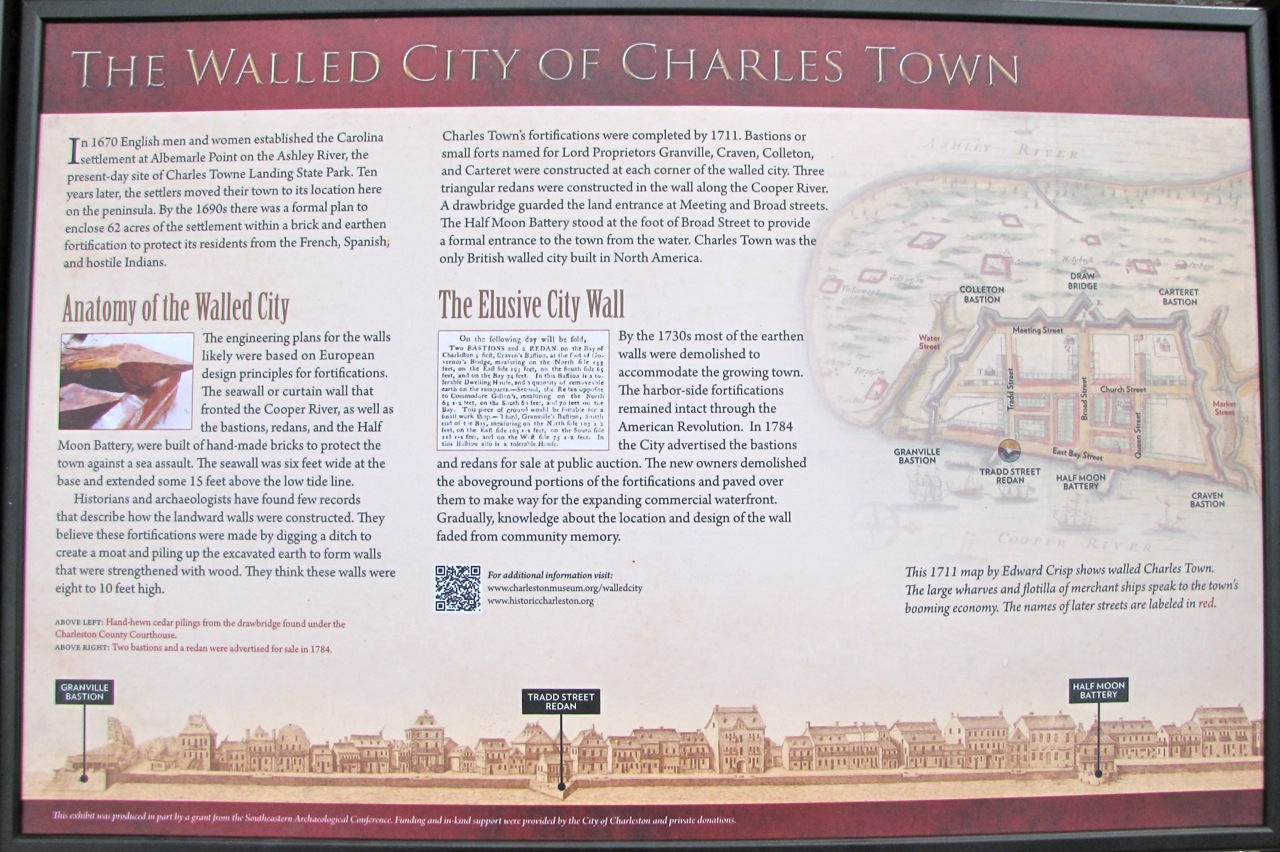
The Mayor’s Walled City Task Force is very pleased to announce that the long-awaited interpretive signage has been installed at the intersection of East Bay Street and South Adger’s Wharf, where archaeological digs in January 2008 and June 2009 uncovered the remnants of the colonial-era redan (or salient angle) that stood at the east end of Tradd Street. The signage consists of two handsome, illustrated text panels, created by the History Workshop, which offer a brief overview of Charleston’s colonial fortifications and also explain the mission of the Mayor’s Walled City Task Force. More importantly, these panels summarize the recent archaeology at South Adger’s Wharf, and serve to mark the site of that important exploration of our city’s colonial fabric. Note also that between the signs stands a small fragment of the parapet (uppermost part of the wall) of the Tradd Street redan that was unearthed from this site during our excavations.  For more information about these panels, take a look at the the following images, or take a stroll down East Bay Street and see them yourself!

Looking northeast from the east end of Tradd Street

Looking southeast from the east end of Tradd Street

Click the image above to enlarge

Click the image above to enlarge

The Archaeological Society of South Carolina will hold its annual Fall Field Day at Charles Towne Landing State Historic Site on Saturday, 9 October 2010, from 10 a.m. to 4 p.m. That’s Tomorrow, folks! Field Day events include displays, demonstrations, lectures, artifact identification, and educational programs. It will be a fun, family friendly day, so we hope to see you there!

You can find a list of the events by following this link to the Field Day Program.

Directions to the event can be found at the website of Charles Towne Landing.

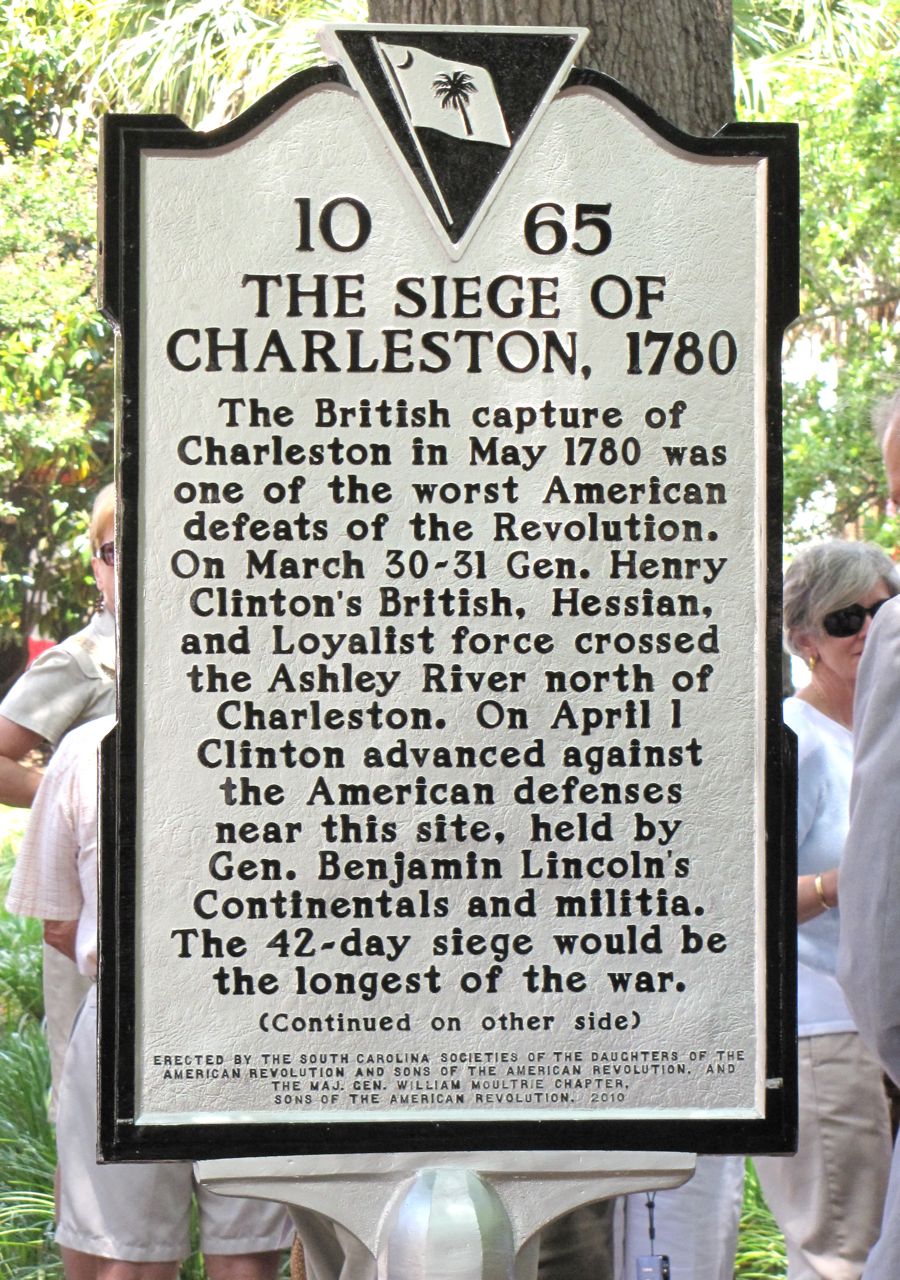
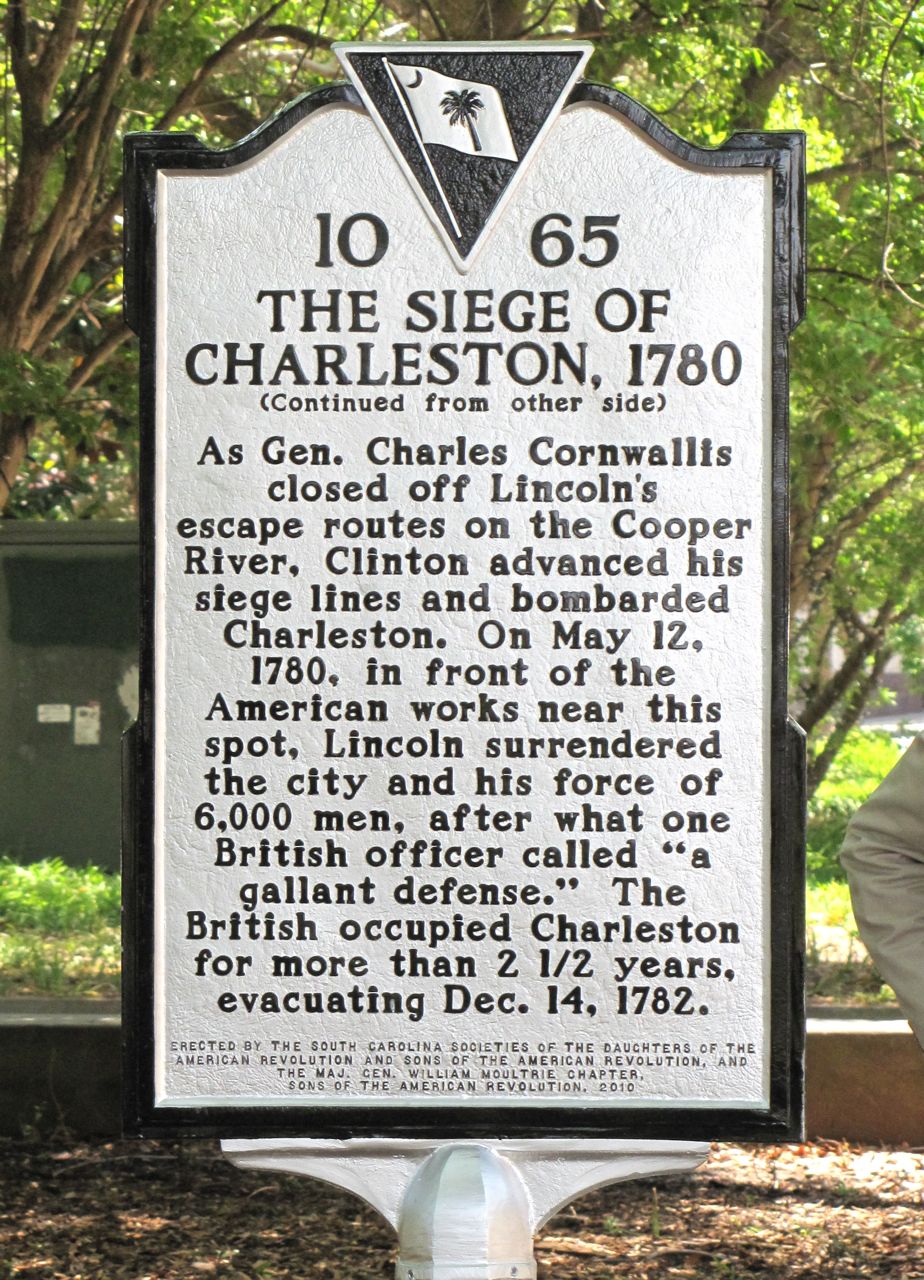
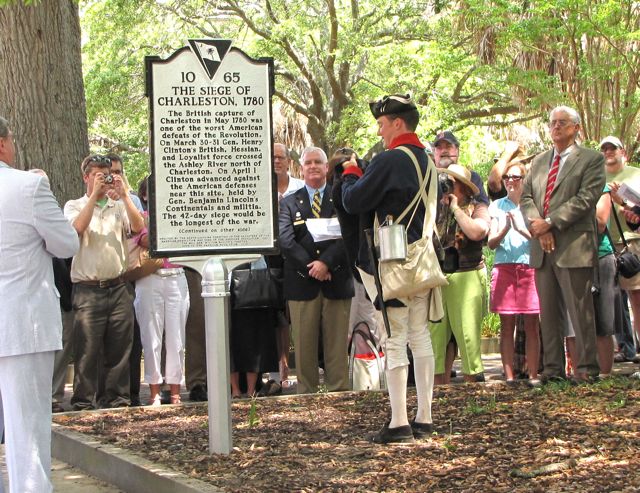
At noon today in Charleston, a crowd of more than fifty ladies and gentlemen gathered in Marion Square to witness the unveiling of a new historical marker commemorating the six-week British siege of the city in 1780 and the 230th anniversary of the surrender of Charleston.

South face of the new marker

North face of the new marker

The marker, placed at the western edge of Marion Square, next to the east side of King Street, briefly summarizes the British siege and its significance to the larger story of the American Revolution. Before today, there was no signage of any kind to acquaint passing residents and tourists with the dramatic story of the siege and the military significance of the site. For those of you who haven’t yet seen the marker, I  photographed both sides for your reading pleasure.

The west side of Marion Square represents the center of the American defensive line during that fateful siege. Between 1757 and 1759 a large tabby fortress, a “Horn Work,” was erected on the site, and it served as the gateway into the city for the next twenty-five years. Between 1776 and May 1780, the American forces also built a series of elaborate fortifications north of and on each side of the Horn Work, stretching the entire distance between the Ashley and Cooper Rivers. The British army landed on the northern neck of the Charleston peninsula at the end of March 1780 and relentlessly bombarded the American defenders as they crept southward towards these defensive works. After a six-week siege, the American forces surrendered the town to Sir Henry Clinton just after noon on the 12th of May, 1780. It was the most elaborate siege in the course of the American Revolution, and the capitulation of Charleston proved to be the largest American surrender during the war. Anyone interested in learning more about the events leading up to the surrender of Charleston on 12 May 1780 should read Carl Borick’s book, A Gallant Defense: The Siege of Charleston, 1780 (University of South Carolina Press, 2003).
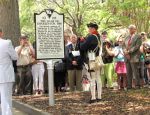
Mark Maloy (center) unveils the new marker

We all owe a great debt of gratitude to Mark Maloy, who spearheaded the campaign to erect the marker and coordinated the group effort to draft its text. Over the course of about seventeen months, Mark brought together a number of organizations that endorsed and helped bring the project to fruition, including the Maj. Gen. William Moultrie Chapter of the Sons of the American Revolution, the South Carolina Society of the Sons of the American Revolution, the South Carolina Society of the National Society of the Daughters of the American Revolution, the Washington Light Infantry/Sumter Guards Board of Officers, the City of Charleston, the South Carolina Department of Archives and History, and Sewah Studios. Hats off to Mark and all the supporters–Huzzah!

« Previous PageNext Page »