Charleston


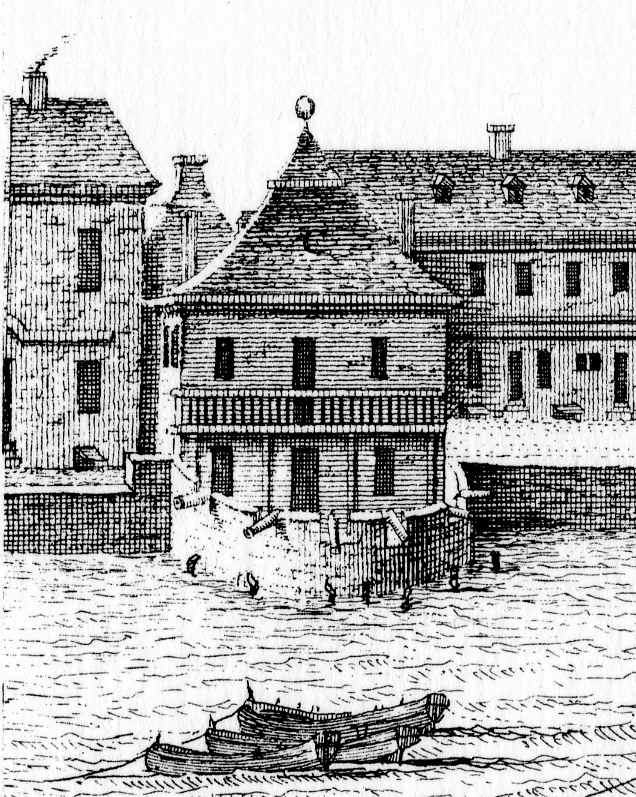
1739 view of the Half-Moon Battery by Bishop Roberts

1739 view of the Half-Moon Battery by Bishop Roberts

Charleston’s Half Moon Battery, located under the Old Exchange Building, is the only remnant of our early colonial fortifications that is currently accessible by the public. Constructed more than three centuries ago, this brick battery served as the center point of the nascent town’s waterfront defenses until it was razed to street level in 1768 for the construction of what was then called the “New Exchange.” Its existence was subsequently forgotten for many generations, but since being rediscovered in 1965 it has been open for public viewing.

The surviving records of South Carolina’s colonial legislature contain very scanty evidence of the design and construction of the Half Moon Battery, and even less information about the “Watch House” that was erected along the western edge of the battery. After a “nice scrutiny” of the evidence (to quote a phrase from those records), however, I have concluded that the brick, Half Moon Battery was constructed in 1701–2, and the one-story “stone” Watch House was erected sometime between 1698 and 1703. Readers familiar with the Bishop Roberts’ 1739 “Exact Prospect of Charles-Town” will note that the latter structure appears in that publication as a two-story building called the “Council Chamber above & Guard House below.” The same aforementioned colonial legislative records also reveal that the early “Watch House” was enlarged into a two-story government structure in 1727, and acquired its new name by the spring of 1731.

What else do the surviving records of South Carolina’s early government reveal about the construction of the Half Moon Battery? Unfortunately, not very much. After pouring over the extant documentary evidence, and a limited amount of archaeological evidence from the 1960s, however, I’ve been working on a three-dimensional model of the battery that will hopefully give us a better idea of its construction and appearance. It’s all a work in progress, but I’ll be offering my latest thoughts and conclusions in the next “Walled City” program this Wednesday:

“The Half Moon Battery, 1701–1768: A Charleston Landmark”

Time: Wednesday, April 23d 2014 at 6:00 p.m.

Place: Second Floor Classroom, Charleston County Public Library, 68 Calhoun St., 29401.

Looking north along the east face of Granville's Bastion

Looking north along the east face of Granville’s Bastion

Last week I had an opportunity to visit Granville’s Bastion, under the Missroon House (headquarters of the Historic Charleston Foundation) at 40 East Bay Street, with Walled City Task Force co-chair, Katherine Pemberton. With the aid of a couple of shop lights, a tape measure, and a compass, we were able to take a number of photos and measurements that will aid our future efforts to document and re-imagine the former appearance of this late-seventeenth-century structure. As you can see in the photo here, a significant portion of the bastion’s once-mighty walls remain intact under the Missroon House, even after the bastion was razed to street level in 1785. In fact, nearly the entire length of its east face, measuring approximately ninety feet from south to north, still stands approximately four feet above the sand. Using plats and descriptions dating from the 1690s to the 1990s, in conjunction with these physical remains, there is still much to learn about the design and construction of this historic structure.

Want to learn more about Granville’s Bastion, the brick “fortress” that guarded the southeast corner of colonial Charleston? Please join me for a free program at the Charleston County Public Library titled:

“Granville’s Bastion, 1696–1785: Charleston’s First Brick Fortress.”

Time: Wednesday, March 26th 2014 at 6:00 p.m.

Place: Second Floor Classroom, Charleston County Public Library, 68 Calhoun St., 29401.
In the autumn of 2012 I presented a lecture illustrating the rise and fall of Charleston “wharf wall” or “curtain line,” a massive brick line of fortification stretching nearly 2,600 feet along the colonial town’s Cooper River waterfront. Since that time the Walled City Task Force has located and exposed a small portion of that wall, and I’ve refined my theories about its design and appearance.  Later this month, on February 26th 2014, I’ll continue our monthly series of “Walled City” lectures by presenting an updated history of this important feature of colonial Charleston. In addition to showing the usual array of maps and historical documents, I’ll reveal my latest conceptual drawings of what I think the old “wharf wall” looked like between the 1690s and the 1780s. If you’d like to learn more about this topic—the longest standing and most expensive part of Charleston’s colonial fortifications—please join us for a free lecture at the Charleston County Public Library:

Charleston’s “Wharf Wall”:

Frontline of our Colonial Fortifications”

Time: Wednesday, February 26th 2014 at 6:00 p.m.

Place: Second Floor Classroom, Charleston County Public Library, 68 Calhoun St., 29401.
Missed a Walled City program in 2013? Have no fear–I’m going to repeat the entire series in 2014! Each month I’ll present a different lecture on a specific feature of Charleston’s colonial fortifications, fresh with updated conclusions and new digital bells and whistles. At the bottom of this post, you’ll find a one-page description of the twelve-part series. Feel free to download and share this flyer. Remember to check this blog site each month to learn the date and time of each program–there may be a few scheduling changes down the road.

Our first 2014 program, on Wednesday, January 22nd, will provide an overview of the first century of Charleston’s fortifications, when the town’s urban landscape was dominated by defensive walls, moats, drawbridges, and cannons. These features dictated the growth of the town, but the story of their evolution and expansion between the 1680s and the 1780s isn’t yet found in any history books. Please join us for this free event!

“The Urban Fortifications of Colonial Charleston, 1680–1789”

Time: Wednesday, January 22nd 2014 at 6:00 p.m.

Place: Second Floor Classroom, Charleston County Public Library, 68 Calhoun St., 29401.

2014 Fortification Lectures (PDF file)

2014 Fortification Lectures (PDF file)

Last month’s “Walled City” program focused on one specific structure—the “Horn Work” that straddled King Street between 1757 and 1784. That large fortification served as the centerpiece of Charleston’s counterattack during the British siege of 1780, but it was just a small part of the town’s defenses. Between the autumn of 1775 and the spring of 1780, local forces erected an expansive network of fortifications that literally surrounded the town (excepting only marshes considered “impassable”). The materials used to construct these works ( including brick, tabby, palmettos, and earth) and their locations reflect the defensive strategy conceived by the American forces in anticipation of an inevitable British attack. Despite these preparations, the town’s defenses were overpowered by the British Army in May 1780, and the fortifications lingered in disrepair until the end of the war in 1783.

If you’d like to learn more about this topic, please join Dr. Nic Butler and the Walled City Task Force for an illustrated survey titled

“Charleston’s Fortifications of the American Revolution, 1775-1783”

Time: Monday, November 25th at 6:00 p.m.

Place: Second Floor Classroom, Charleston County Public Library, 68 Calhoun St., 29401.

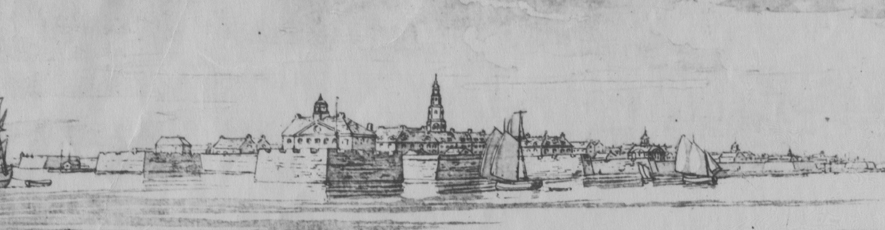
Detail from a 1777 map of Charleston harbor

Detail from a 1777 map of Charleston harbor

« Previous PageNext Page »