Charleston


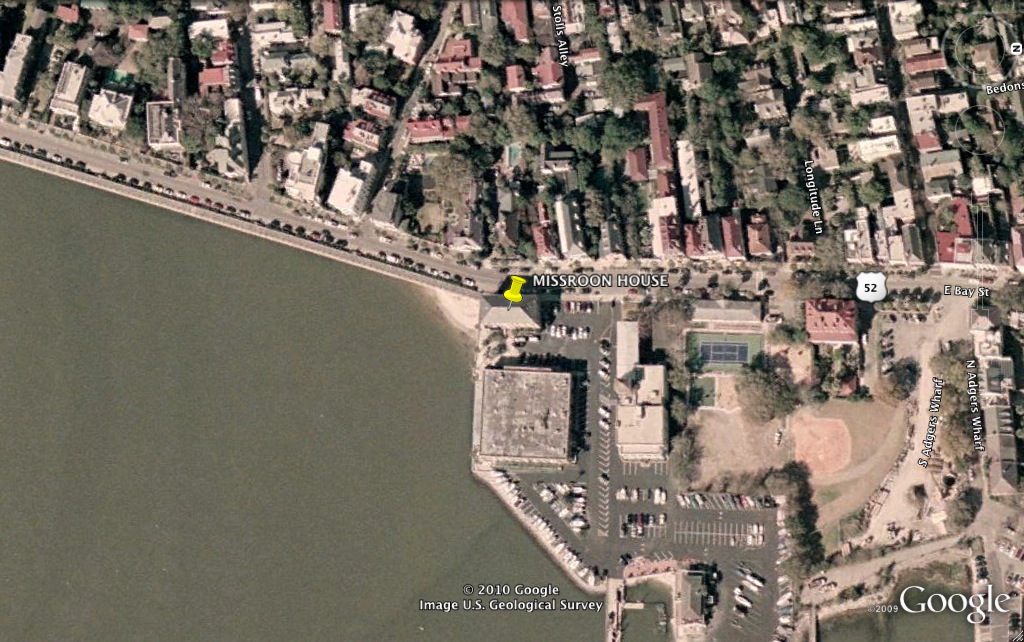
Missroon House (center)

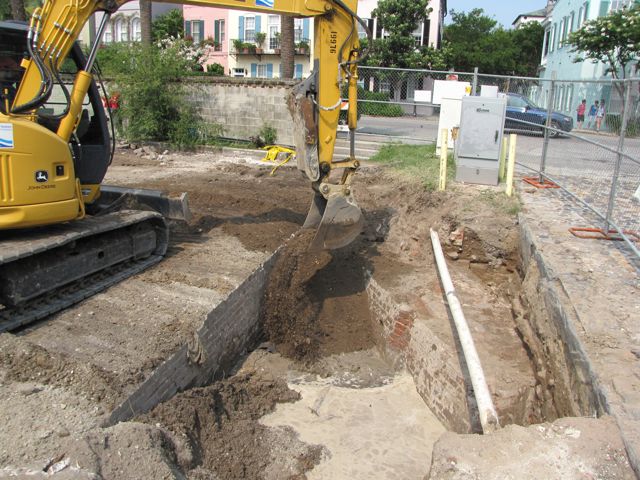
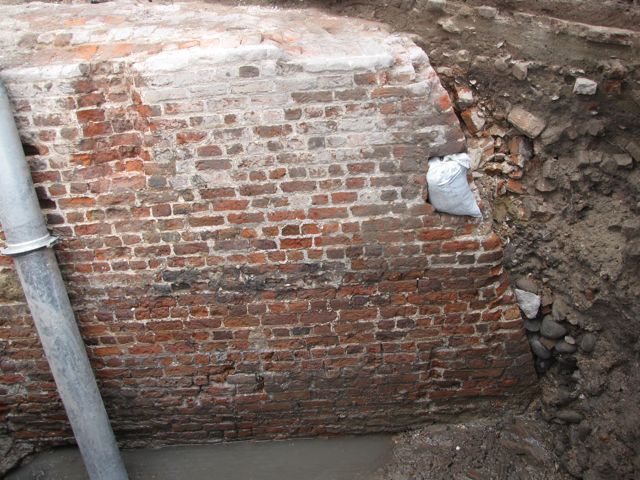
On 21 December 2009, a City of Charleston’s stormwater drainage crew parked next to the Missroon House, No. 40 East Bay Street, to address a routine problem. Their equipment had detected a subterranean leak in the main drain running down the center of East Bay Street, near the point where East Bay Street becomes East Battery Street. After opening a small hole in the asphalt road surface, the work crew dug a few feet down and found the leak in the old nineteenth-century brick arched drain. In the process, they also uncovered a small portion of the south wall of Granville Bastion.

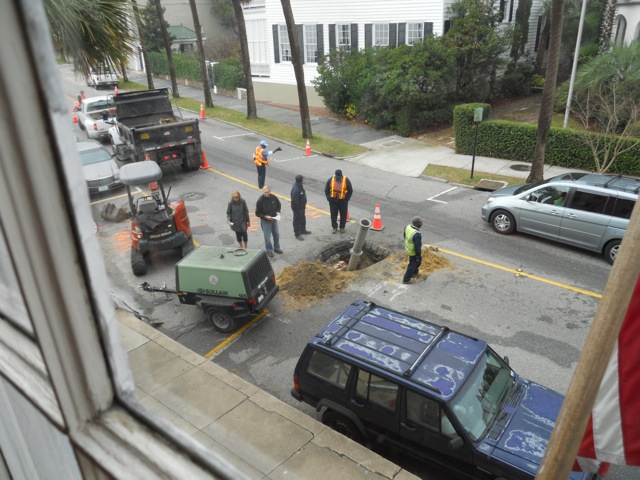
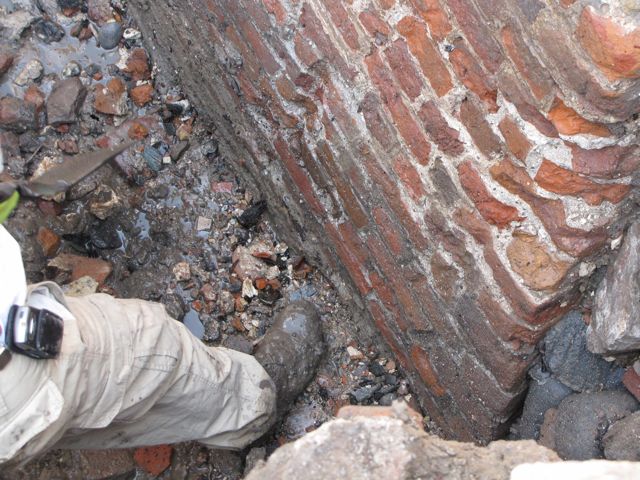
Walled City Task Force co-chair Katherine Saunders was right on the spot since the Missroon House, the home of the Historic Charleston Foundation, literally sits directly on top of the eastern portion of Granville Bastion. With her iPhone, she snapped a few photographs to document both the location and the materials. As you can see in the photos below, the nineteenth-century drain, constructed of grayish bricks on the right, intersects the bright reddish-orange bricks of the colonial bastion. The Task Force encountered a very similar phenomenon while digging at South Adger’s Wharf in January 2008. In both cases, the colonial brickwork was excised just enough to make room for the drain

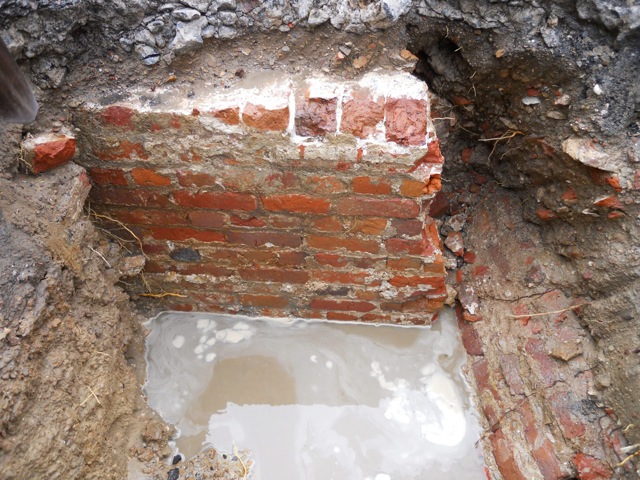
Granville Bastion was the first and the largest of Charleston’s brick bastions, commissioned by an act of the legislature in late 1696. During the early years of the eighteenth century it was frequently called simply “the Fort” because of its size and its importance to the town’s waterfront defenses. It was here that each of the colonial governors was formally welcomed, and the birthdays of the king and queen of England were publicly toasted.

While this brief sighting on 21 December 2009 did not include any exploratory digging or archaeological investigation, it did provide valuable confirmation that substantial remnants of Granville Bastion survive under the roadbed of modern East Bay Street. A substantial portion of southeast corner of Granville Bastion is exposed under the foundation of the Missroon House, several yards east of the street, but that area is not easily accessible and is not open to the public. For the time being, the remnants of Charleston’s first brick “fort” lie safely hidden beneath the modern hardscape, invisible to the throngs of tourists walking along the High Battery along Charleston’s picturesque waterfront.
Sometime after the creation of the Mayor’s Walled City Task Force in the summer of 2005, I set a research goal for myself. If one were going to write a proper history of urban Charleston’s colonial fortifications, I thought, one should read through all the surviving legislative records from that era. Since the City of Charleston was not incorporated until 1783, there was no City Council during the colonial era, and thus the duty of building, maintaining, and dismantling the urban fortifications was performed by the provincial legislature.  More specifically, the Commons House of Assembly, the forerunner of the modern state House of Representatives, did the bulk of the legislative work. Since the “Commons” administered the disbursement of money from the treasury (through the Public Treasurer or Receiver, of course), the surviving journals of the Commons House contain more evidence of the rise and fall of the “Walled City” than any other source.

We are fortunate that nearly all of the handwritten journals of South Carolina’s Commons House of Assembly—dozens of leather-bound volumes spanning the years from 1692 to 1775—have survived into the twenty-first century. There are a few small gaps here and there, of course, and unfortunately the most egregious lacuna is the missing journal of 1718–1719. In that long-lost journal would be the records of the trial of the pirate Stede Bonnet and his crew as well as the records of the bloodless Revolution of December 1719. All of the surviving Commons House journals can be found at the South Carolina Department of Archives and History (SCDAH) in Columbia. Approximately one half of these journals have been published (see the Selected Bibliography page), but the rest are accessible only at SCDAH.

After nearly four years of work, I am proud to announce that I have now read through all of the surviving journals of the South Carolina Commons House of Assembly, 1692–1775, and transcribed all of the materials therein relating to the urban fortifications of colonial Charleston. Along the way I lost track of how many volumes and pages I had read, but I can say with confidence that this task involved tens of thousands of pages of rather dreary legislative proceedings. From this work I have amassed more than 400,000 words of raw notes ( typed into my trusty Apple laptop) relating to Charleston’s fortifications. Adding in materials transcribed from other primary sources (mostly colonial statutes and Journals of the South Carolina House of Representatives, 1776–1794), I now have approximately 500,000 words of raw notes.

So what’s next on the research front of this Task Force? Now I’m now reading through all of the surviving journals of the His Majesty’s Council for the Province of South Carolina, 1721–1775. This branch of the colonial legislature served as a sort of “privy council” for the governor, advising him on various projects and policies. While the journals of the Council are not as numerous as those of the Commons, they do contain some unique information relating to the fortifications of urban Charleston. So far I’ve read through these journals up to 1743, and I hope to complete this task by the end of 2010.

From all of this evidence derived from primary sources, a book-length treatment of the history of Charleston’s colonial fortifications will eventually be distilled. I promise.

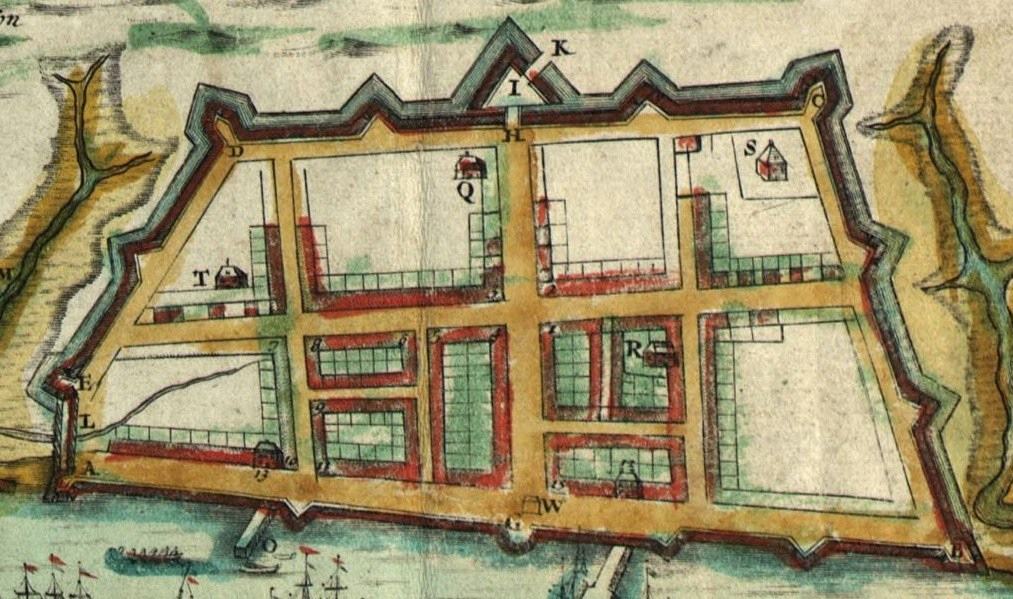
Recently I’ve been asked about the names of the streets illustrated in the “Crisp Map” of 1711. This map, published in London in 1711, depicts the small urban settlement of Charles Town confined within a system of walls. A number of features in the town are marked with letters or numbers and identified in an accompanying “Explanation” or key. Unfortunately, the names of the streets are not included in this key. By referring to other contemporary documents, however, we can identify the street names with some confidence.

When the “Crisp Map” was published in 1711, the South Carolina legislature had not yet legally confirmed the names of any of the streets in Charles Town. In 1722–23, during the short-lived incorporation of what was known as “Charles City and Port,” the provincial legislature contemplated the official naming of the streets as part of a complete re-survey of the town. The British Parliament disallowed the incorporation of Charles Town, however, and the matter was dropped. Again during the mid-1730s, the South Carolina legislature ordered a re-survey of the town and in 1736 attempted to pass an act to confirm the names of the streets. This measure failed, but in a separate act the name of Dock Street was legally changed to Queen Street. By the middle of the eighteenth century, the remaining street names of Charles Town had become so well established by common usage that they resisted change. Only after the incorporation of the city of Charleston in 1783 did the municipal government regard street names as fixed titles that required legislation to alter.

In the absence of “official” street names in 1711, therefore, the streets of Charles Town were designated by fairly flexible system of nomenclature. The street along the waterfront of the Cooper River, for example, was commonly called “the Bay” or “the Bay street” or “Front Street.”  Today it’s called East Bay Street, but that name doesn’t become common until the mid-1700s. The broad central thoroughfare perpendicular to the river was originally designated “Cooper Street,” in honor of Lord Anthony Ashley Cooper, the first Earl of Shaftesbury, but the descriptive name “Broad Street” has endured in common usage for more than three hundred years. Several early legislative records mention “South Street” and “North Street” as the other two principal thoroughfares in early Charles Town. These names were occasionally used to designate the two streets parallel to Broad Street, which we now call Tradd Street (south of Broad) and Queen Street (north of Broad).

The surviving records of the early granting and conveying of town lots in urban Charles Town contain many references to streets. From these records, which date back to the 1680s, we learn that street names were most frequently determined by prominent landmarks along their path. The “South Street” perpendicular to the Cooper River, running past the house of Richard Tradd, was commonly called “Mr. Tradd’s Street” (today’s Tradd Street). Similarly, the “North Street” ran past Edward Loughton’s dock (built in 1706) near the bay and was best known as Dock Street (today’s Queen Street). The Street that ran past the Anglican church was called “Church Street” until the church moved in the 1720s. At that time the street in front of the new Church became “New Church Street” (today’s Church Street), and the street by the old church became “Old Church Street” Since the mid-1700s, however, Old Church Street has been more commonly called “Meeting Street” because its path also ran past the Meeting House of the Independent Congregational Church.

Detail from the 1711 "Crisp Map" of Charles Town

Detail from the 1711 “Crisp Map” of Charles Town (click to enlarge)

So what are the names of the streets depicted in the “Crisp Map”? The street fronting the Cooper River is “the Bay” or “Bay Street,” today called East Bay Street, leading from Granville’s Bastion (letter “A” on the map) to Craven’s Bastion (letter “B”). The central street perpendicular to the Bay Street is Broad Street, which leads from the Half Moon Battery and Watch House (letters “G” and “W”) to the town gate (letter “H”). The street leading from Carteret’s Bastion (letter “C”) to Colleton Bastion (letter “D”) was called “Church Street” until the early 1720s, and afterward called “Old Church Street” and then “Meeting Street.” The central street parallel to East Bay Street and Meeting Street did not officially have a name when Crisp published this map, but in the early 1720s it became known as New Church Street, and is now simply called Church Street. The street parallel to and immediately south (left) of Broad Street is Tradd Street, while the street parallel to and immediately north (right) of Broad Street is Queen Street. The narrow street parallel to and between Broad and Tradd Streets is Elliott Street. The narrow lane connecting Tradd and Elliott Street is Bedon’s Alley. The narrow lane connecting Broad Street and Queen Street was called Union Street after the political union of England and Scotland in 1707, but was renamed State Street in 1811. The narrow lane connecting Union Street and New Church Street was called Beresford’s Alley (now Chalmers’ Street).

Note, however, that the streets depicted at extreme south (left) and extreme north (right) of the town represent a bit of artistic license. These streets were not part of the original town plan, known as the Grand Model of Charles Town, and, if they ever truly existed, they disappeared after the earthen walls were dismantled ca. 1730.  Today’s Water Street was created from the creek depicted south (left) of the town in the Crisp Map, and today’s Cumberland Street was created in 1747 near the site of the north (right) town wall depicted in this map.

Yesterday I neglected to thank Robert Behre, columnist with the Charleston Post and Courier, for his good article (and video) of the “buried treasure” that has been uncovered at the east end of Tradd Street this month. Over the past several weeks his three articles about this dig have definitely enhanced our visibility, and we appreciate the public attention given to this educational venture.

thousands_of_artifacts

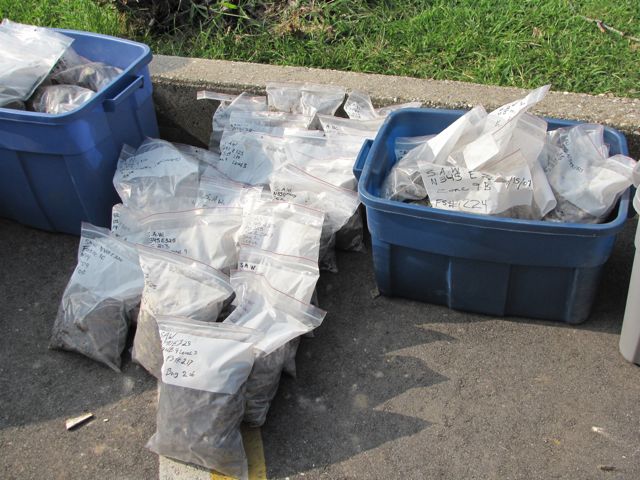
Bags of artifacts ready for the lab at the Charleston Museum

Since the digging finished yesterday, the dozen College of Charleston archaeology students helped Martha Zierden of the Charleston Museum to sort the labeled bags of artifacts accumulated during the past four weeks. Martha says the total number of ceramic sherds, bottle fragments, bone, and other items is still unclear, but it’s definitely in the thousands. A few double glazed windows in perfect condition were retrieved, it’s clear however that many windows did not get so lucky. The task of processing and preserving this material begins now and will continue for many months. This long and laborious project costs money, too, so we ask everyone to please consider donating to the Walled City Task Force or directly to the Charleston Museum in order to help Martha with this important work.

striking_the_set

Striking the set on on the final day of the dig

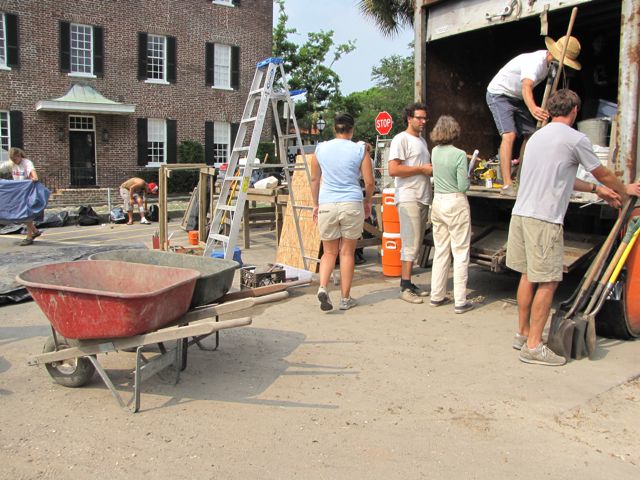
This plan for this dig was hatched by the Mayor’s Walled City Task Force many, many months ago, but it was conducted this month as a “field school” course through the College of Charleston. The students laboring here in the sun and rain over the past four weeks  are receiving course credit for their work, and this morning they had their final exam. Following that somber ritual, the students and and their course leaders, Martha Zierden and Barbara Borg, gathered all the tools, equipment, supplies, and artifacts and began packing up the Museum’s old field truck. Like the end a theatrical run, the actors on this archaeological stage pitched in to strike the set and say a bittersweet goodbye to the experience.

The only task remaining was to re-cover the redan that they have worked so hard to unearth. Compared to the past four weeks of painstaking, meticulous digging and study, the process of filling the excavation units went by in the blink of an eye. For this task we turned over the stage to two familiar faces, James “Tiny” Bonnett and Leroy Young of Charleston Water System, who so ably assisted us with heavy equipment in January 2008 and again this week. Leroy brought in fresh fill dirt to cover the redan, and James gingerly directed the backhoe to move the dirt into position and tamped it down. Below are a few photos of this “finale.”

dirt_fillcovering_the_redandig_site_looking_south

The fence and signage at the dig site will remain for a few more days, and next week the city will repave the portion of asphalt parking lot disturbed by this project.

Many visitors to the dig site have expressed dismay that we planned to fill the excavation at the end of June. Exposed to the elements, especially direct sunlight, however, the old brick and wood that we’ve been studying would rapidly begin to decay and crumble. It’s in everyone’s best interest to protect this historic site, and re-covering it offers the best short-term solution. Until such time as there is a plan for a safe and secure method of displaying or viewing the remnants of the old redan, we’ll just let it rest. Once a plan has been designed and approved, then the money must be secured to bring the plan to fruition. In the near future we’ll definitely be beating the drum to raise funds for this purpose, and we hope members of the community will express their enthusiasm for creating a window into the past by lending a hand. If you feel inclined to assist in funding such a project I encourage you to contact Katherine Saunders, co-chair of the Mayor’s Walled City Task Force and associate director of preservation at the Historic Charleston Foundation.

Don’t forget about the upcoming program at the Charleston County Public Library on Tuesday, June 30th, at 6:30 p.m. We’ll review the past four weeks of archaeology and talk about all the lessons learned during this great experience. Please come!

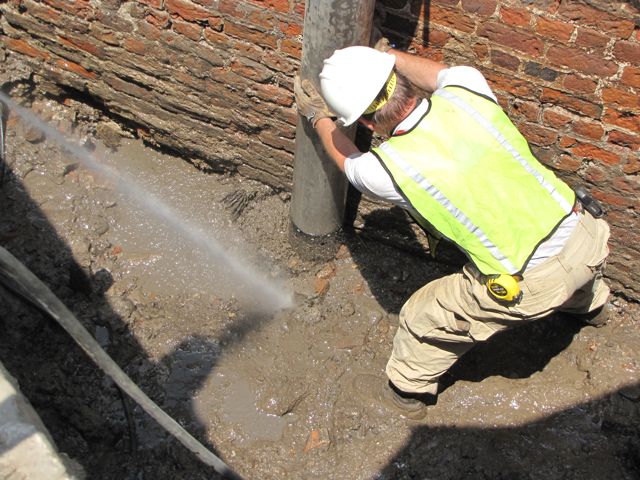
I am so thankful to have had the opportunity to participate in today’s digging at the historic east end of Tradd Street. I will always remember this miserably hot, intolerably bright June day as one of the highlights of my life in Charleston. With the skilled assistance of team members from Charleston Water System, the city’s Storm Water Service, and Dr. Eric Poplin‘s intrepid coaxing of the city’s mega-vacuum, we got to the bottom of the redan brickwork, more than eight feet below the top of the redan, and studied its foundation. In short, we traveled back in time to take a brief once-in-a lifetime peek at the handiwork of African and European laborers in Charleston in the late 1690s.

Poplin_assisting_vaccumvacuum_nozzlePoplin_at_redan_nose

(click the images above to enlarge)

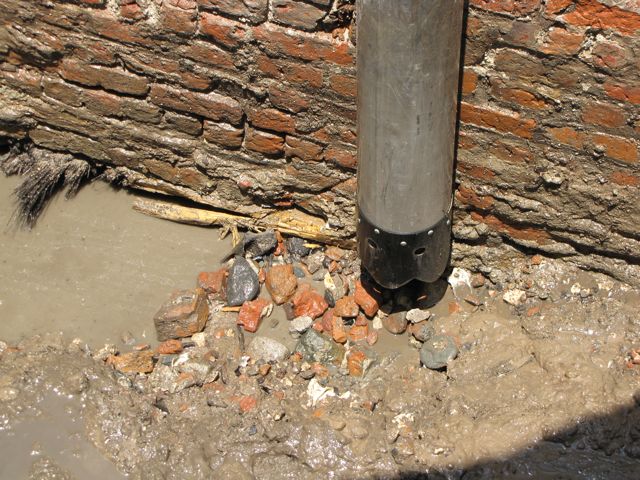
The bulk of the day was spent scooping and vacuuming out the water, mud, brick bats, pebbles, and ballast stones from an area about ten feet along the south face of the base of the redan’s south wall, extending approximately three feet  southward from the exposed brick (see the photos above). The goal was to find the bottom edge of the brick, to study the foundation for this massive wall of solid brick, and to record its dimensions. By the end of the day, we had the answers that we had been so eagerly awaiting. I took a dozens of photographs and even some video of this activity, but it will take me a few days or weeks to digest and edit this material. For the moment, therefore, I’ll simply summarize the findings and report more at a later date.

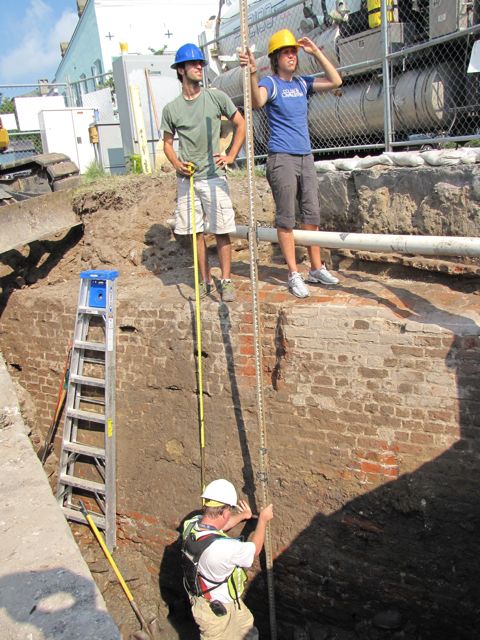
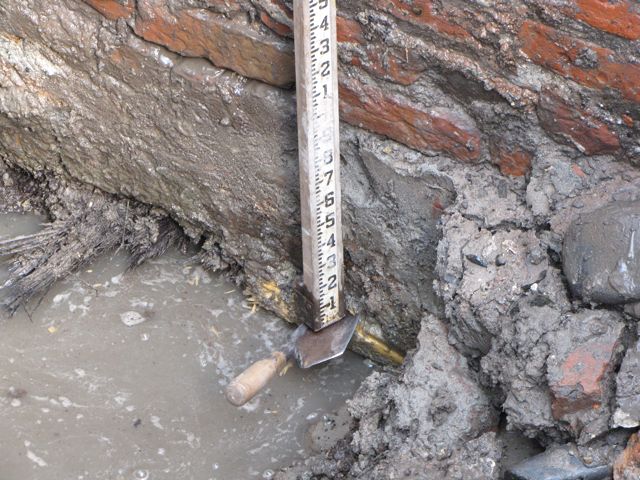
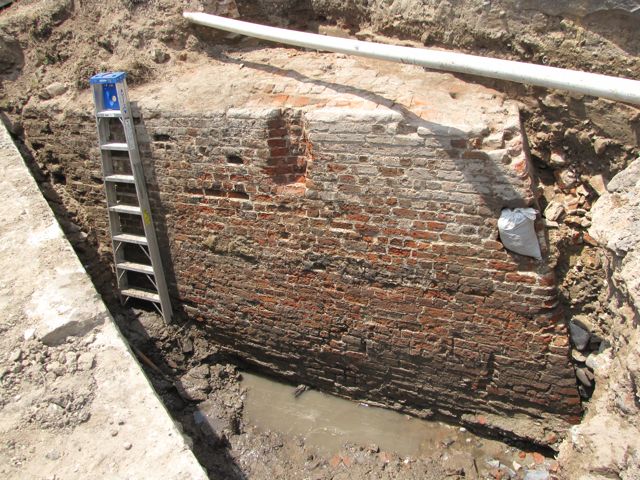
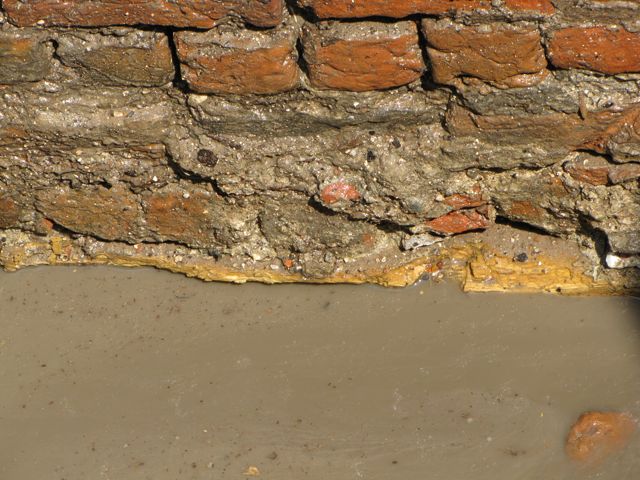
IMG_0549The brickwork of this redan extends 101 inches—nearly eight and a half feet—from the exposed top surface, along the outer slope of the wall, down to the bottom of the lowest brick course. If one remembers that prior to 1785 this wall extended a further six feet above their street level, then it is truly impressive to think that this was once a solid mass of bricks approximately fourteen feet high. The photo at left shows College of Charleston students with archaeologist Eric Poplin recording the height and location of the bottom of the wall. Below left is an image of the measuring instrument perched on Eric’s trowel at the base of the wall. Below center and right are probably the my best and last views of the full scale of the redan’s exposed south face.

IMG_0556IMG_0633IMG_0590

(click the images above to enlarge)

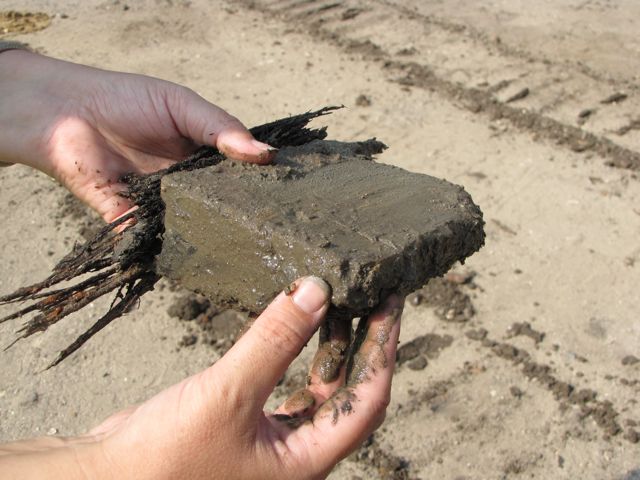
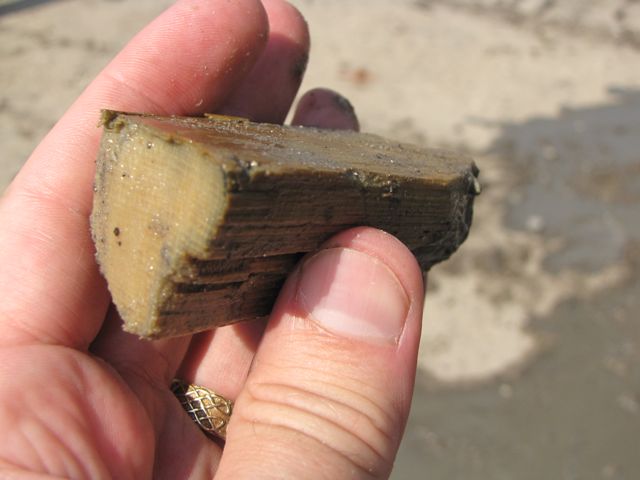
At the level where the brickwork ends, approximately eleven to twelve feet below modern street level, we found a line of cypress planks, approximately two inches thick, which appear to run parallel to the edge of the bricks. Since we used a backhoe (a step up from yesterday’s smaller track-hoe) to clear away part of the mud from this area, a few chunks of this cypress plank were brought to the surface (see the photos below). As you can see, it looks as if it had been hewn yesterday.

IMG_0585IMG_0536IMG_0563

(click the images above to enlarge)

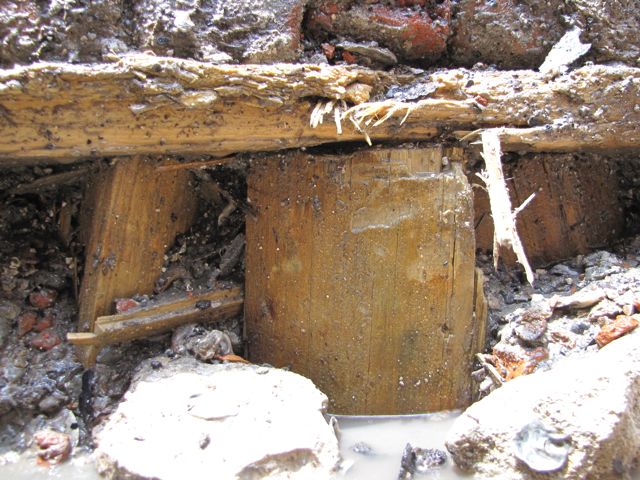
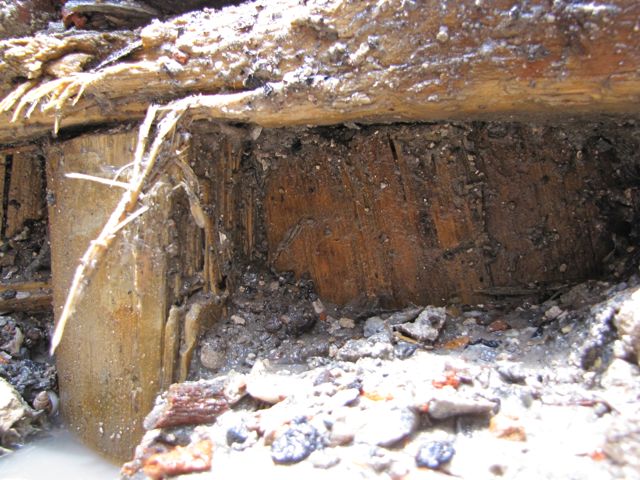
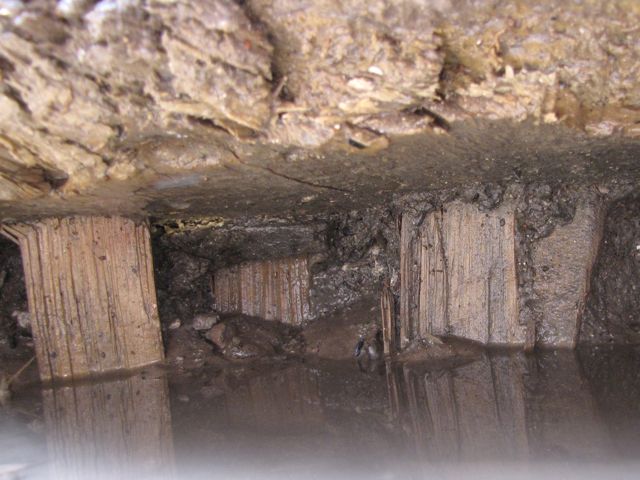
We were not surprised to see cypress planks under the brick because architects Albert Simons and Samuel Lapham reported seeing the same when they encountered the foundation of Granville’s Bastion during their expansion of the Missroon House (40 East Bay Street) in 1925. At that time Simons and Lapham also reported seeing, but did not photograph, palmetto lots directly below their cypress planks, so we expected to see palmetto, too. Today, however, we learned that the cypress planks of this redan are resting on a thick nest of small vertical cypress piles.

IMG_0616IMG_0617IMG_0621

(click the images above to enlarge)

The three images above are the first photographs ever taken of a foundation of Charleston’s waterfront fortifications, which commenced building in the late 1690s (see our time line). As you can see, the horizontal cypress planks, which were a little damaged by our excavation, are pressing all the weight of the bricks above them onto a number of vertical, rough-hewn cypress stakes of varying sizes. We saw no signs of palmetto logs below this material. I am ecstatic to have had the privilege of climbing ankle-deep in the mud with Dr. Poplin to see this first hand. I hope our readers are similarly impressed!

Today was the final day of digging. Friday morning the excavated areas will be refilled with fresh dirt, and next week a layer of asphalt will return. Yes, there is talk of designing a permanent “window” of some sort over the redan, but nothing has yet been designed and no money raised for its construction. If you feel inclined to assist in funding such a project I encourage you to contact Katherine Saunders, co-chair of the Mayor’s Walled City Task Force and associate director of preservation at the Historic Charleston Foundation.

Don’t forget about the upcoming program at the Charleston County Public Library on Tuesday, June 30th, at 6:30 p.m. We’ll review the past four weeks of archaeology and talk about all the lessons learned during this great experience. Please come!

« Previous PageNext Page »