
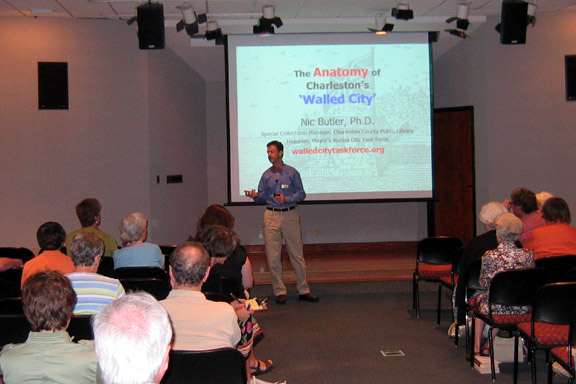
 Thank you to everyone who attended Saturday’s program, “The Anatomy of Charleston’s Walled City.” Based on the numerous questions and positive comments received afterwards, I feel confident that the audience left with a better understanding of the materials and design principles used to build the defensive walls that surrounded colonial Charleston. I hope all 72 of you in attendance found it an educational and entertaining way to spent the afternoon.On Saturday, I was also pleased to make two new public announcements on behalf of the Task Force: first, the availability of this new website, and second, the upcoming archaeology to be done at South Adger’s Wharf (see the 14 September posting by Katherine Saunders). We sincerely hope that this electronic forum will help us raise awareness of Charleston’s colonial fortifications and encourge the public to learn more about this fascinating topic.For those of you who weren’t able to attend on Saturday, I’ll be repeating the program on Monday, 29 October 2007, at 7:00 p.m., in the Auditorium of the Charleston County Public Library.
fortifications
18 September 2007
“Anatomy” Program a Success
Posted by Nic Butler, Ph.D. under archaeology, Charleston, fortifications, history, Nic Butler, programs1 Comment
14 September 2007
Archaeology at South Adger’s Wharf!
Posted by kasaunders under archaeology, Charleston, fortifications, history, South Adger's Wharf[2] Comments
Limited explorations of some of the harborside fortifications were conducted in the early and mid 20th century in Charleston. While these excavations were were certainly informative, there have been no complete, systematic archaeological investigations that have focused on the early brick fortifications of Charles Town and many questions remain. An opportunity to find answers through excavation of one of the brick defensive features of the walled city currently exists at the intersection of East Bay Street and South Adger’s Wharf. This is the site of one of the brick redans. Inside this redan was located a governmental building, labeled “court house” in a 1739 engraving of the town. Just to the east of the redan was the lower market of the town. Excavations at this site have the potential to yield important information about the early fortifications as well as other significant aspects of life in colonial Charles Town.
The location of the redan is made clear through documentary sources like a highly detailed plat from 1784. The site of the redan is just opposite Tradd Street, where South Adger’s Wharf begins. The ballast stones in South Adger’s Wharf were taken up when work was set to begin on a public works project nearly. The city of Charleston and Charleston Water System made the decision to map, remove, and store the stones so that they would not incur damage from heavy machinery rolling over them. Currently, the first 60 feet of South Adger’s Wharf moving east from East Bay Street is covered with only a layer of asphalt. The replacement of the ballast (cobble) stones is scheduled to be completed in the Fall of 2007 at an approximate cost of $25,000.
The Mayor’s Walled City Task Force has proposed that a systematic archaeological dig be accomplished at the site before the stones are replaced. Both the City Engineers office and Charleston Water System have pledged to work with the Task Force in this endeavor with loan of equipment, issuance of permits, etc. The Walled City Task Force anticipates that a thorough, professional archaeological excavation can be accomplished within a few weeks and at an approximate cost of $50,000.The work will be conducted by in late October or early November by archaeologist Martha Zierden and by Brockington and Associates.
TheWalled City Task Force is committed to making the excavations and results part of an ongoing educational outreach program for the public, especially for school age children, to learn more about the walled city and colonial Charleston as well as the importance of historical archaeology.
The City of Charleston has donated $25,000 to the project and both Historic Charleston Foundation and the Charleston County Public Library have pledged staff time. However, we are still looking for additional funds. If you would like to make a tax-deductible contribution, please contact Katherine Saunders at ksaunders[AT]historiccharleston.org.
9 September 2007
Anatomy of Charleston’s “Walled City”
Posted by Nic Butler, Ph.D. under Charleston, fortifications, history, Nic Butler, programsLeave a Comment
 The most frequently asked questions about the fortifications that surrounded colonial Charleston relate to their size and composition. What were they made of–and how were they built? In the continuing series of “Walled City” lectures at the Charleston County Public Library, Dr. Nicholas Butler will present an illustrated discussion of the of the design and materials of these fortifications. A question and answer session will follow the lecture.
Saturday, 15 September 2007
2:00 p.m.
Charleston County Public Library Auditorium
68 Calhoun Street
Charleston, SC 29401
 Subscribe via email
 Rediscovering Charleston's Colonial Fortifications