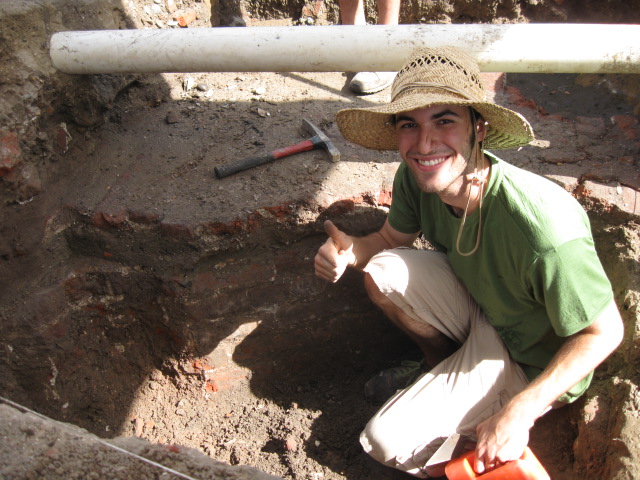
Thumbs up!

Thumbs up!

Success!  Day five was noteworthy for our first glimpse of the redan!  This exciting discovery prompted camera crews from Channel 5 and Channel 4 to come to the site today—be sure to watch the evening news tonight!

The big news came this morning when archaeologists digging in a unit directly adjacent to South Adger’s Wharf came across a portion of angled brick wall.  We’ve identified this as the outer wall of the redan’s south face.
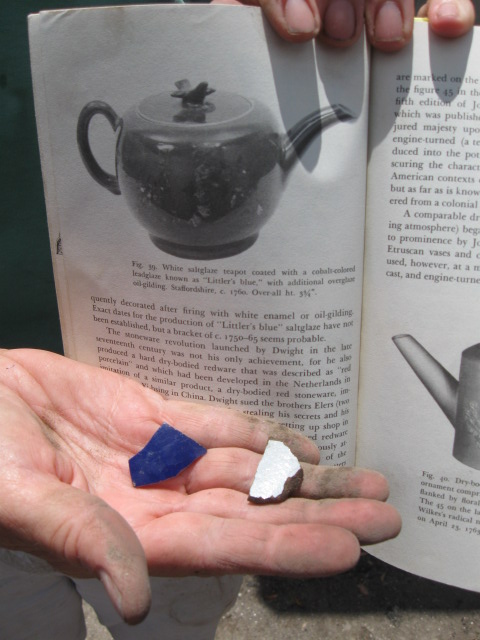
Rare ceramic find

Rare ceramic find

The redan was found directly underneath the brick market pavers that were put in place 1784 and 1786.  In 1784, the South Carolina Gazette reported on several recommendations for the city including a recommendation “that the market called the Lower Market, be immediately paved, as in its present situation, it is extremely offensive and disagreeable to the inhabitants, and others who resort there.”   After mapping and photographing the pavers yesterday and today, the archaeologists have carefully removed many of them.  This will continue on Monday as we continue to trace more of the redan’s south face.
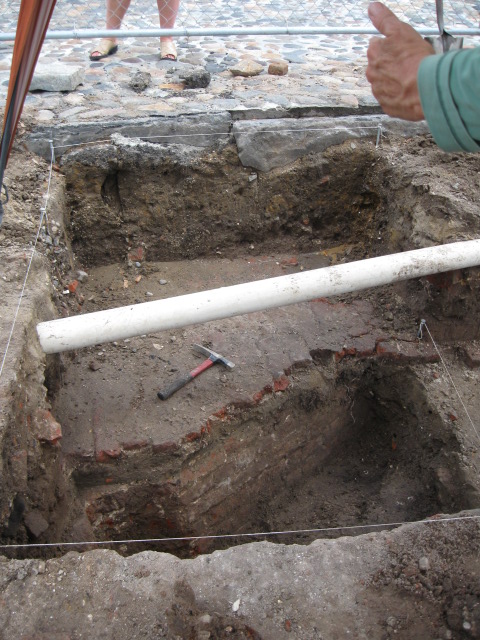
The brick redan

The brick redan

The location of the south redan face in the area of the parking lot closest to S. Adger’s Wharf is good news.  It seems possible that the builders of Vanderhorst’s north tenement may have built that structure adjacent to the brick remains of the redan, rather than directly on top of it.  It’s also good news because we may be better able to interpret this feature to the public in the future without disrupting much of the city’s parking lot.  Depending on where the rest of the redan wall is located and how much remains, we may be able to explore the possibility of “glassing-over” the brickwork, or, at least, somehow marking the outline of the redan.
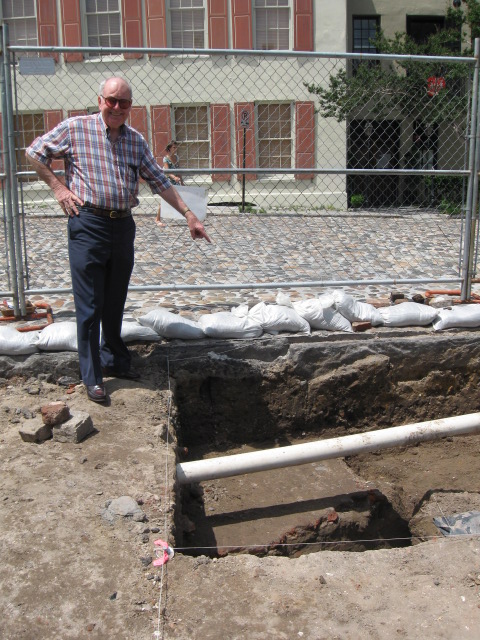
Walled City Co-Chair Peter McGee checks out the redan

Walled City Co-Chair Peter McGee checks out the redan

Monday’s digging should reveal more of the redan—be sure to stop by the site if you can and stay tuned!

The upcoming archaeological investigations now scheduled for early January (2008) are intended to uncover some important components of the eighteenth century Walled City of Charles Town. We are hopeful that we can locate, map, and study the remains of the redan and the lower market that were located on the site. Here’s a sneak peek at what we’re looking for.

Tradd St Redan, 1739

The Redan
This small structure, known as a redan, was part of the main line of colonial fortifications that faced Charleston Harbor. This line of brick fortifications was begun along the east side of the Bay Street in the 1690s. Based on European fortification design principles of the day, the angled walls of the redan allowed the five or six cannon mounted within to fire at a wider range of potential targets, and thus better protect the curtain wall and the city from naval assault. When it was built three hundred year ago, the Cooper River washed the redan’s brick walls at high tide. Since that time, the mud flats on the east side of East Bay Street have been built up with silt, ballast stones, trash, and other materials.By 1784 or 1785, when the redan at the east end of Tradd Street was finally removed, an extensive wharf stood between it and the channel of the Cooper River. This extension of Tradd Street is now known as South Adger’s Wharf.

The Lower Market, 1751-1799
A major fire in November 1740, which burned nearly half of Charleston, destroyed the Exchange and Court Room that had recently been built at the east end of Tradd Street. The site sat vacant for several years, except for the presence of the brick redan at the foot of Tradd Street. In 1750 the S.C. legislature approved the building of a new market on a growing wharf on the east side of the brick redan, and construction continued into 1751. From the 1750s onward, the structure was known as the “Lower Market,” to differentiate it from the Beef Market (the site of present City Hall), and provisions of all kinds were sold here, but not slaves. According to a resolution of Charleston City Council in late 1785, after the old brick redan was finally removed, the Lower Market was enlarged, however, it was still too small to accommodate Charleston’s growing market needs, and the site was becoming too congested by the post-Revolutionary expansion of the wharves. In an effort to consolidate the city’s market activities in the new Market Street, this market was closed in 1799, and the city sold the property in early 1800.

Limited explorations of some of the harborside fortifications were conducted in the early and mid 20th century in Charleston. While these excavations were were certainly informative, there have been no complete, systematic archaeological investigations that have focused on the early brick fortifications of Charles Town and many questions remain. An opportunity to find answers through excavation of one of the brick defensive features of the walled city currently exists at the intersection of East Bay Street and South Adger’s Wharf. This is the site of one of the brick redans. Inside this redan was located a governmental building, labeled “court house” in a 1739 engraving of the town. Just to the east of the redan was the lower market of the town. Excavations at this site have the potential to yield important information about the early fortifications as well as other significant aspects of life in colonial Charles Town.

The location of the redan is made clear through documentary sources like a highly detailed plat from 1784. The site of the redan is just opposite Tradd Street, where South Adger’s Wharf begins. The ballast stones in South Adger’s Wharf were taken up when work was set to begin on a public works project nearly. The city of Charleston and Charleston Water System made the decision to map, remove, and store the stones so that they would not incur damage from heavy machinery rolling over them. Currently, the first 60 feet of South Adger’s Wharf moving east from East Bay Street is covered with only a layer of asphalt. The replacement of the ballast (cobble) stones is scheduled to be completed in the Fall of 2007 at an approximate cost of $25,000.

The Mayor’s Walled City Task Force has proposed that a systematic archaeological dig be accomplished at the site before the stones are replaced. Both the City Engineers office and Charleston Water System have pledged to work with the Task Force in this endeavor with loan of equipment, issuance of permits, etc. The Walled City Task Force anticipates that a thorough, professional archaeological excavation can be accomplished within a few weeks and at an approximate cost of $50,000.The work will be conducted by in late October or early November by archaeologist Martha Zierden and by Brockington and Associates.

TheWalled City Task Force is committed to making the excavations and results part of an ongoing educational outreach program for the public, especially for school age children, to learn more about the walled city and colonial Charleston as well as the importance of historical archaeology.

The City of Charleston has donated $25,000 to the project and both Historic Charleston Foundation and the Charleston County Public Library have pledged staff time. However, we are still looking for additional funds. If you would like to make a tax-deductible contribution, please contact Katherine Saunders at ksaunders[AT]historiccharleston.org.